




How Technical Zipper Design Reduces Seams, Bulk and Material Layers in Apparel
By hqt
10, 2026Related Posts
How Should Brands Evaluate Zipper Performance for High-End Outdoor Clothing?
November 17, 2026
Notape pitches lighter repairable zippers
November 16, 2026
130 Years Later, Cars Were Reinvented by Electrification. What About the Zipper?
October 12, 2026
Waterproof Zipper without Coating Supplier | NOTAPE™ No Coating Zipper Technology
September 26, 2026
Beyond the way a garment opens and closes, Technical Zippers also effect construction in a variety of other ways. In a typical construction, the zipper area consists of fabric, folded seam allowances, zipper tape, stitching, reinforcement, and possibly even sealants. Although each of these elements is relatively thin, if they are combined in a single area, they may create bulk and rigidity in fabric.
Because of these various impacts of zipper construction, the current trend in zipper design is to shift the focus to closure architecture and away from the teeth and sliders. With different connection techniques to the garment, it is possible to reduce seams, overlaps and superfluous layers while still retaining the mechanical function for actual use.
Why Conventional Zipper Installation Creates Bulk
A conventional zipper uses a chain with textile tape on both sides. During construction, the tape is joined to the fabric using a sewing or other joining technique.
The installed cross-section may therefore include:
•Outer garment fabric
•Folded seam allowance
•Zipper tape
•Stitching or bonding area
•Reinforcement around high-stress zones
•Seam tape or another barrier in weather-resistant garments
This means zipper bulk is not determined by zipper weight alone. It is a system-level construction issue.
A lightweight zipper fitted through a complicated seam structure may still create a relatively stiff area. This becomes particularly noticeable in thin jackets, technical sportswear, packable clothing, and other garments where the surrounding fabric is soft and flexible.
| Construction Factor | Structural Effect | Possible Garment Impact |
| Zipper tape | Adds another material layer | Wider attachment zone |
| Folded seam allowance | Doubles fabric locally | Increased thickness |
| Stitching area | Requires attachment space | Reduced edge flexibility |
| Reinforcement | Adds support material | Higher local stiffness |
| Seam sealing | Adds a functional layer | More complex cross-section |
How a Technical Zipper Can Reduce Material Layers
The main difference in an advanced Technical Zipper is often not simply a thinner component. The more important change is how the closure is integrated into the garment.
Traditional construction can be simplified as:
Garment Fabric → Seam Allowance → Zipper Tape → Stitching
A more integrated Technical Zipper approach may reduce reliance on one or more of these intermediate layers.
1. Reducing Conventional Zipper Tape
Zipper tape occupies width and creates another overlap between the closure and garment fabric. A tape-free architecture can reduce this structural layer rather than merely replacing it with a thinner version.
2. Reducing Attachment Seams
A conventional sewn zipper requires a seam around the closure. That seam also requires an allowance and sufficient material for attachment.
Reducing conventional seams can therefore affect more than appearance. It may simplify the complete zipper-zone cross-section.
3. Integrating the Closure With the Garment
The engineering goal shifts from “attach a zipper to the garment” toward “integrate the closure into the garment structure.”
This distinction matters because fewer overlapping layers can potentially reduce local thickness and bending stiffness. The actual result, however, depends on fabric type, attachment technology, reinforcement requirements, zipper length, and garment design.
Technical Zipper vs Conventional Zipper Construction
A Technical Zipper should not automatically be considered better simply because it contains fewer layers. The correct choice depends on application requirements.
| Factor | Conventional Tape Zipper | Integrated Technical Zipper |
| Textile zipper tape | Normally required | May be reduced or eliminated |
| Traditional seam | Common | May be reduced |
| Material overlap | Usually higher | Can be simplified |
| Local bulk | Depends on installation | Potentially lower |
| Manufacturing method | Well-established sewing | May require adapted assembly |
| Strength | Depends on zipper and seam | Must be independently verified |
| Water resistance | Requires suitable construction | Must also be tested separately |
For lightweight apparel, reducing layers can be particularly useful because even small changes in local stiffness may be noticeable against thin fabrics.
Other special kinds of closures are heavily used in workwear, outdoor equipment or other high-load closures. In these cases the focus may be more on sideways strength, retention of stoppers, repetitive loading and failure rate.
This is why thin does not automatically mean technically superior.
Fewer Seams Still Require Mechanical Verification
One common misconception is that removing zipper tape or seams automatically makes a garment weaker. The opposite assumption—that a simplified design is automatically stronger—is equally unreliable.
A Technical Zipper should be evaluated with measurable performance data.
Important verification points include:
•Horizontal tensile strength: Resistance to lateral separation
•Top stopper strength: Ability of the stopper to remain secure under load
•Open-tail strength: Important for open-end jacket zippers
•Pin displacement strength: Evaluates stability of the insertion system
•Load/strain cycles: Indicates response to repeated mechanical loading
•Washing appearance: Checks whether construction changes visibly after laundering
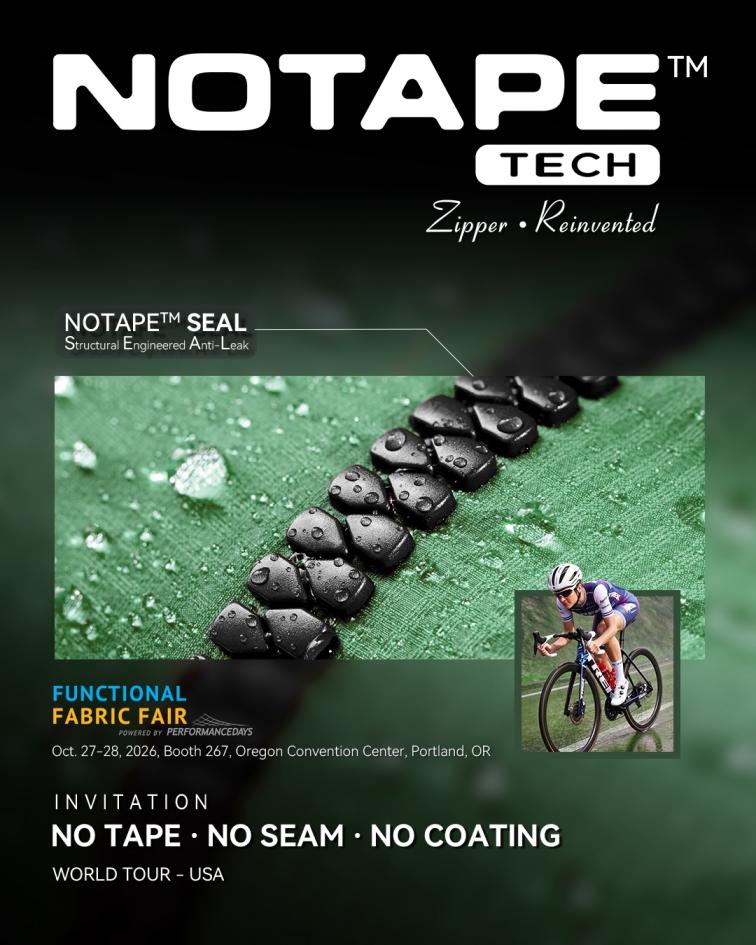
NOTAPE™ provides one example of this verification-based approach. Its technology offers a No Tape & No Seam Zipper architecture and physical-performance for both Coil and Resin Zippers. The company provides horizontal tensile, stopper, open-tail, pin-displacement, load/strain-cycle, and washing-related evaluations, and offers the test results meet or exceed applicable EU, US, and Chinese industry standards.
Its technology also offers separate water-resistant certification for NOTAPE™ SEAL. This distinction is important because seamless construction does not automatically mean waterproof or water-resistant; resistance to liquid penetration must be evaluated separately.
Where Reduced-Layer Technical Zipper Design Matters Most
An reduced-layer Technical Zipper can be useful when standard zipper construction creates a stiff, bulky area.
Some examples are:
•Lightweight outdoor jackets: A balance of low bulk, flexibility, closure strength, and weather protection needs to be designed for outerwear.
•Performance sportswear: Local flexibility and movement of the garment can be designed into areas of the attachment zone.
•Packable apparel: A zipper can be designed to close a garment in a compact, space saving volume.
•Minimalist and technical fashion: Seams can be designed to be completely closed and integrated to create a cleaner, more seamless look.
Always material reduction must be considered in conjunction with garment level testing. A zipper may work exceptionally well as a stand alone component; however it may not behave the same way when integrated with a fabric and a certain construction method.
How to Select a Technical Zipper
Before selecting a Technical Zipper, designers and sourcing teams should ask more than whether it is “seamless.”
A practical evaluation sequence is:
Garment Application → Fabric Weight → Required Closure Strength → Layer Strategy → Attachment Method → Water-Resistance Requirement → Mechanical Testing → Garment Testing → Supplier Verification
Key supplier questions include:
•What traditional layers or components have actually been removed?
•Is zipper tape eliminated, reduced, or replaced?
•How is the zipper connected to the garment?
•How is lateral strength verified?
•Are stopper and open-tail strength data available?
•Has repeated loading been evaluated?
•What happens after washing?
•Is water resistance independently tested?
•Does the construction require changes to garment assembly?
These questions separate meaningful Technical Zipper technology from a closure that is simply thinner or visually cleaner.
A well-designed Technical Zipper should simplify garment architecture without treating structural performance as an assumption. For apparel developers examining tape-free and seam-reduced closure systems, NOTAPE™ offers a practical example of this approach through its No Tape & No Seam architecture, Coil and Resin Zipper technologies, and published performance-testing framework.
Designers and sourcing teams can explore NOTAPE™ Technical Zipper technology to evaluate whether a more integrated closure structure fits the material, construction, and performance requirements of their next apparel project.
FAQs
Q1: Can we view videos or technical materials showing the zipper manufacturing process?
Depending on the stage of cooperation and mutual evaluation between parties, and as sample testing and customized development progress, certain process-related technical materials may be gradually shared with clients.
Q2: How are the zipper top stop and bottom stop handled?
The zipper structure is formed using patented equipment and specialized process treatments.
Q3: What makes NOTAPE™ zippers uniquely different?
we come at a premium — because true innovation is rare. NOTAPE™ is not available to every brand. By integrating our no tape zipper technology, your products gain a level of exclusivity and uniqueness that sets them apart.
Q4: Are there requirements regarding fabric type or thickness when using NOTAPE™ zippers?
Currently, NOTAPE™ technology is more suitable for synthetic fibers such as nylon and polyester, as well as woven, knitted, low-elastic, or non-elastic fabrics.
The applicability of other materials is still under development and testing.
Q5: Does every garment using a NOTAPE™ zipper require customization?
Good question.
Not every piece requires customization, but each zipper style must undergo preliminary validation testing before production.



Contact Us
In This Article
Related Posts
How Should Brands Evaluate Zipper Performance for High-End Outdoor Clothing?
November 17, 2026
Notape pitches lighter repairable zippers
November 16, 2026
130 Years Later, Cars Were Reinvented by Electrification. What About the Zipper?
October 12, 2026
Waterproof Zipper without Coating Supplier | NOTAPE™ No Coating Zipper Technology
September 26, 2026


