




Tapeless Zipper Supplier for Premium Sportswear and Athleisure Brands
By hqt
11, 2026Related Posts
How Should Brands Evaluate Zipper Performance for High-End Outdoor Clothing?
November 17, 2026
Notape pitches lighter repairable zippers
November 16, 2026
130 Years Later, Cars Were Reinvented by Electrification. What About the Zipper?
October 12, 2026
Waterproof Zipper without Coating Supplier | NOTAPE™ No Coating Zipper Technology
September 26, 2026
A lightweight running jacket may use a soft, flexible fabric, yet its front closure can introduce a comparatively rigid strip. Tape width, seam allowances, slider clearance and fabric stretch all affect how that area lies against the body.
At NOTAPE™, we regard zipper selection as a garment-engineering decision, not simply a trim purchase. A Tapeless Zipper Supplier should help designers assess the entire zipper–fabric interface.
What Is a Tapeless Zipper?
In a conventional zipper, the elements are supported by textile tapes, which are stitched to the garment panels. The tape distributes opening forces but adds another material layer and two attachment lines.
A tapeless zipper removes that intermediate textile tape. The critical engineering question then becomes how the elements transfer load into the garment fabric without distorting its edge.
NOTAPE™ develops tape-free coil zippers and tape-free, seamless resin zippers using proprietary equipment. These are distinct constructions; “tapeless” should not automatically be read as “no stitching anywhere in the garment.”
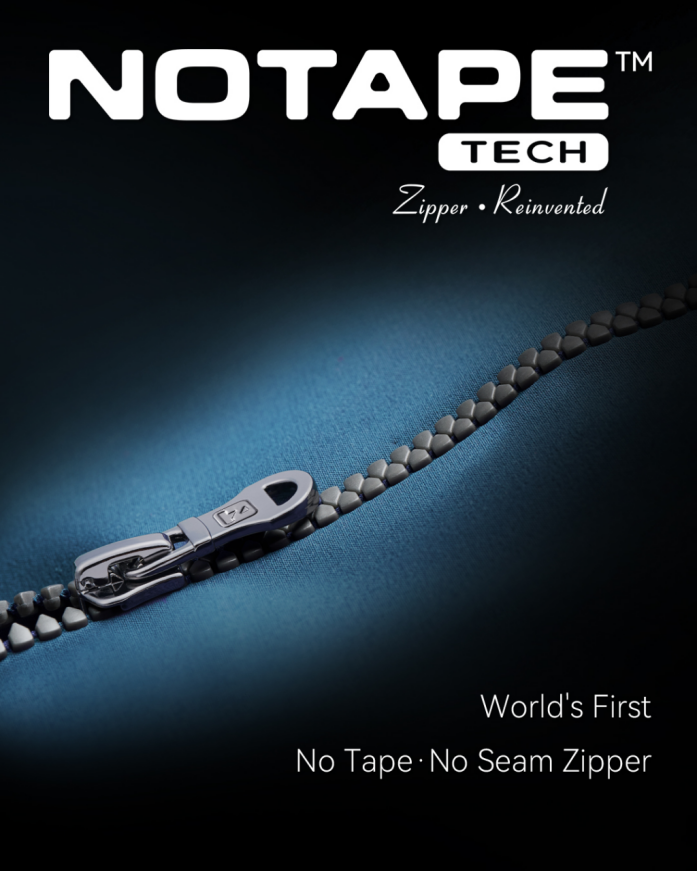
Traditional vs. Tapeless Construction
| Design Factor | Conventional Zipper | Tapeless Construction |
| Element support | Separate woven tape | Engineered integration with garment fabric |
| Attachment zone | Tape, seam allowance and stitches | No conventional tape attachment; process depends on design |
| Profile | Multiple overlapping layers | Potentially thinner transition |
| Load transfer | Through tape and stitch line | Through the engineered element–fabric interface |
| Production | Standard zipper sewing operations | Model-specific equipment and process validation |
| Main design risk | Seam puckering, tape stiffness | Fabric-edge di |
Removing tape does not remove the need for strength. The finished closure still has to tolerate slider movement, lateral loads and repeated garment flexing.
What Are the Different Effects of Construction?
Running shells and windbreakers: A low profile front closure can lay flat against thinner panels. The front closure still needs to withstand repeated wear and pack down.
• Cycling jerseys and jackets: A close fit to the body can create an ugly wave or twist when the rider bends over. Also, consider lateral loading.
• Athleisure, sweatpants, and sets: Designing a seamless front, can be done with minimalist design, but the zipper still needs to remain smooth after washing and drying.
• Tech, Urban: Integrated closures can conceal tape and stitching without having a fully concealed zipper.
For each application, the Tapeless Zipper Supplier needs the actual shell fabric, not just the name on the spec sheet.
Fabric Compatibility: What Must Be Checked?
NOTAPE™ currently identifies nylon and polyester, including certain woven and knitted, low-stretch or non-stretch fabrics, as more suitable candidates.
A Tapeless Zipper Supplier cannot establish compatibility from fiber content alone. Our first-stage review considers:
• Construction: Weave or knit stability, yarn movement and edge fraying.
• Thickness and surface: Coating, lamination, texture and local thickness variation.
• Mechanical response: Stretch and recovery in both fabric directions, particularly across the opening.
• Garment geometry: Zipper curvature, seam intersections, hem tension and required slider clearance.
Highly elastic fabrics need particular care: an extensible panel beside a comparatively stable closure can concentrate stress at the interface. A fabric swatch and prototype are more informative than a generic compatibility claim.
How Should a Tapeless Zipper Supplier Validate Performance?
A useful development program tests the assembled closure, not only an isolated zipper chain.
| Evaluation | What the Team Should Inspect |
| Opening/closing cycling | Slider movement, element engagement and changes after repeated use |
| Crosswise and longitudinal loading | Separation, permanent deformation and fabric-edge damage |
| Attachment integrity | Peeling or detachment under relevant pulling directions |
| Laundering and care | Puckering, dimensional change, appearance and operation after care cycles |
| Wear simulation | Bending at the waist/chest, abrasion and repeated folding |
| Production trial | Repeatability of alignment, end stops and finished opening dimensions |
Acceptance limits should come from the garment’s intended use and the buyer’s quality protocol; one numerical threshold cannot represent every sportswear category.
Does Tapeless Mean Water-Resistant?
No. Water resistance is a specific product function, not an automatic property of all tape-free zippers.
NOTAPE™ SEAL uses a structural physical barrier rather than a conventional water-resistant film or coating on zipper tape. Its design also removes the usual tape-sewing line, one potential path for water entry.
A Tapeless Zipper Supplier should still recommend water-ingress testing on the assembled garment, including end stops, adjacent seams and any protective flap. Water-resistant is not synonymous with waterproof.
Can Removing Tape Reduce Environmental Impact?
Eliminating textile tape removes a material component and associated tape-processing steps.
That is a verifiable construction difference, not proof that every finished garment has a lower carbon footprint.
Comparative claims require defined system boundaries, material data, manufacturing inputs, service-life assumptions and, where appropriate, life-cycle assessment.
Develop the Closure Alongside the Fabric
At NOTAPE™, we work with apparel teams to assess the fabric, intended use and required closure behavior before proposing a tapeless construction.
If your next premium sportswear or athleisure project calls for a lighter-looking, more integrated fastening line, explore our technology at NOTAPE™ and share your fabric sample and design brief for a technical discussion.
FAQs
Q1: What types of garments can NOTAPE™ zippers be used for? Can they be used for bags, hats, or cases?
NOTAPE™ currently focuses on the high-end apparel segment, primarily covering down jackets, windbreakers, lightweight jackets, and business-formal garments.
If future application directions are updated, we will inform our partners in a timely manner and share relevant technical and application information accordingly.
Q2: How is NOTAPE™ different from other “”Tape-free sewn”” zippers solutions?
Does it require sepcial sewing machinery?
Thank you for your interest in NOTAPE™ zipper. The key difference are:
1. NOTAPE™ offers globally exclusive no tape coil zipper and no tape, no seam resin zipper.
2. NOTAPE™ zippers are based on proprietary patented technologies
If you’re open to share your industry and brand, we can provide more relevant technical details.
Q3: Is NOTAPE™ a copy or imitation?
No. NOTAPE™ is the world’s first to develop tape-free zipper solutions and holds exclusive patented technologies for both no tape coil zippers and no tape, no seam resin zippers.
Q4: How is NOTAPE™ zipper installed onto fabric? Can it be installed by home sewing machines, or does it require special equipment? Is it glued on?
NOTAPE™ is a global first, featuring proprietary patented technologies for no tape coil zippers and no tape, no seam resin zippers. The zipper is formed as one with the fabric using patented equipment, rather than traditional sewing methods.
Q5: If a NOTAPE™ zipper is damaged, can it be replaced or repaired?
How is it repaired? Will it affect the garment?
Individual zipper teeth on plastic zippers can be repaired without affecting the garment.



Contact Us
In This Article
Related Posts
How Should Brands Evaluate Zipper Performance for High-End Outdoor Clothing?
November 17, 2026
Notape pitches lighter repairable zippers
November 16, 2026
130 Years Later, Cars Were Reinvented by Electrification. What About the Zipper?
October 12, 2026
Waterproof Zipper without Coating Supplier | NOTAPE™ No Coating Zipper Technology
September 26, 2026


