




Lightweight Technical Zipper: How Weight Affects Movement
By hqt
10, 2026Related Posts
How Should Brands Evaluate Zipper Performance for High-End Outdoor Clothing?
November 17, 2026

Notape pitches lighter repairable zippers
November 16, 2026
130 Years Later, Cars Were Reinvented by Electrification. What About the Zipper?
October 12, 2026
Waterproof Zipper without Coating Supplier | NOTAPE™ No Coating Zipper Technology
September 26, 2026
In lightweight apparel, zipper selection should not be based only on whether the closure opens reliably. A Lightweight Technical Zipper also becomes part of the garment’s weight distribution, local stiffness and movement behavior.
This is especially relevant for running jackets, cycling apparel, packable windbreakers, skin jackets and other garments built from thin, low-GSM fabrics. As fabric weight decreases, the difference between the flexible garment panel and a relatively heavy or rigid closure can become more noticeable.
The engineering question is therefore not simply, “How light is the zipper?” It is:
How well does the zipper’s weight, stiffness and structure match the garment around it?
Why Zipper Weight Matters More in Lightweight Garments
Garment developers commonly work toward a total finished-weight target. However, total weight does not explain where that mass is located.
A center-front zipper concentrates material along one continuous vertical line. Traditional construction may combine:
•Zipper elements or coil;
•Textile tape;
•Slider and puller;
•Stops and opening components;
•Stitching;
•Seam allowance;
•Overlapping garment fabric.
On a relatively heavy jacket, several grams at the center front may represent a small proportion of overall garment mass. On an ultralight garment, the same zipper can account for a much larger percentage.
For this reason, evaluating a Lightweight Technical Zipper by grams per zipper—or grams per unit length—is more useful when combined with finished garment weight and fabric GSM.
Garment Balance Depends on Where the Weight Is Located
Two garments with the same total weight may behave differently if their component weight is distributed differently.
The fabric spreads mass across a large surface area. A zipper concentrates it along the closure line. During movement, this localized mass can interact with the garment differently from the surrounding panels.
Possible effects depend on the complete construction but may include:
•Changes in hem balance;
•A more pronounced zipper line;
•Reduced conformity around curved body areas;
•Different movement between the closure and adjacent fabric.
This does not mean that every heavier zipper creates these problems. Garment geometry, zipper length, fabric structure and attachment method all matter.
The practical objective is therefore weight compatibility, not simply minimum zipper weight.
Weight Is Only Half the Problem: Local Stiffness Matters Too
A Lightweight Technical Zipper should also be evaluated as a structural component.
Traditional zipper tape, sewing and folded seam allowances can create a closure zone that is thicker and less flexible than the surrounding garment fabric.
This becomes particularly important when lightweight fabric needs to bend repeatedly during:
•Running and arm swing;
•Cycling in a forward torso position;
•Climbing or hiking;
•Bending and rotation;
•Packing and unfolding.
If the fabric bends easily while the zipper area resists bending, the two structures may respond differently under movement.
This stiffness mismatch can contribute to puckering, bowing or localized deformation, particularly when the garment uses thin or highly drapable materials.
How Fabric GSM and Elasticity Change Zipper Behavior
A zipper should never be evaluated independently from its fabric.
Consider the same closure used on a dense outerwear textile and on a very lightweight performance fabric. Although the zipper itself has not changed, its relative structural influence has.
| Garment Variable | Why It Matters for a Lightweight Technical Zipper |
| Fabric GSM | Lower-GSM fabrics may be more sensitive to trim weight |
| Thickness | Affects closure-area bulk and transition |
| Elasticity | Can create different deformation between zipper and fabric |
| Drape | Determines how easily fabric conforms around the closure |
| Zipper weight | Influences localized garment mass |
| Zipper stiffness | Influences bending behavior |
| Attachment method | Changes thickness, flexibility and load transfer |
| Zipper length | Longer closures increase total component contribution |
This is why specifying only “lightweight zipper” is not enough for technical apparel development.
A Lightweight Technical Zipper should be selected as part of a fabric–closure system.
Lightweight Technical Zipper: What Should Engineers Measure?
The lightest zipper is not automatically the best technical solution.
Removing too much material without considering strength, attachment or repeated operation can create another engineering problem. Product developers should instead evaluate several parameters together.
Component-Level Checks
Measure:
•Complete zipper weight;
•Weight per unit length;
•Zipper size and length;
•Local thickness;
•Bending behavior;
•Slider operation;
•Opening and closing durability.
Garment-Level Checks
After installation, evaluate:
•Closure flatness;
•Zipper-to-fabric deformation;
•Attachment security;
•Garment drape;
•Fit under body movement;
•Performance after washing;
•Repeated opening and closing;
•Abrasion where relevant.
Static inspection on a table or mannequin is not enough for high-movement apparel. A running or cycling garment should also be assessed in positions that reflect its intended use.
Conventional Zipper vs Lightweight Structural Design
There are two basic approaches to reducing zipper influence on lightweight garments.
| Design Factor | Conventional Construction | Lightweight Structural Approach |
| Textile tape | Normally required | May be eliminated |
| Material layers | More overlapping layers | Fewer layers possible |
| Local thickness | Depends on tape and seam design | Can be reduced structurally |
| Weight reduction | Often component-based | Can come from architecture |
| Garment integration | Zipper attached through tape | More direct integration possible |
This distinction is important.
A well-designed Lightweight Technical Zipper does not necessarily achieve lower weight by making critical functional components thinner. Weight can also be reduced by questioning whether every traditional structural layer is necessary.
How NOTAPE™ Approaches Lightweight Zipper Structure
NOTAPE™ applies this principle through its No Tape architecture.
A conventional zipper generally uses textile tape as the intermediate structure between the zipper elements and garment fabric. NOTAPE™ removes that separate tape layer and integrates the zipper structure more directly with the garment material.
The structural change affects more than grams. Removing the tape can also reduce material layering around the closure area, which is relevant when designers are trying to control bulk and stiffness in lightweight apparel.
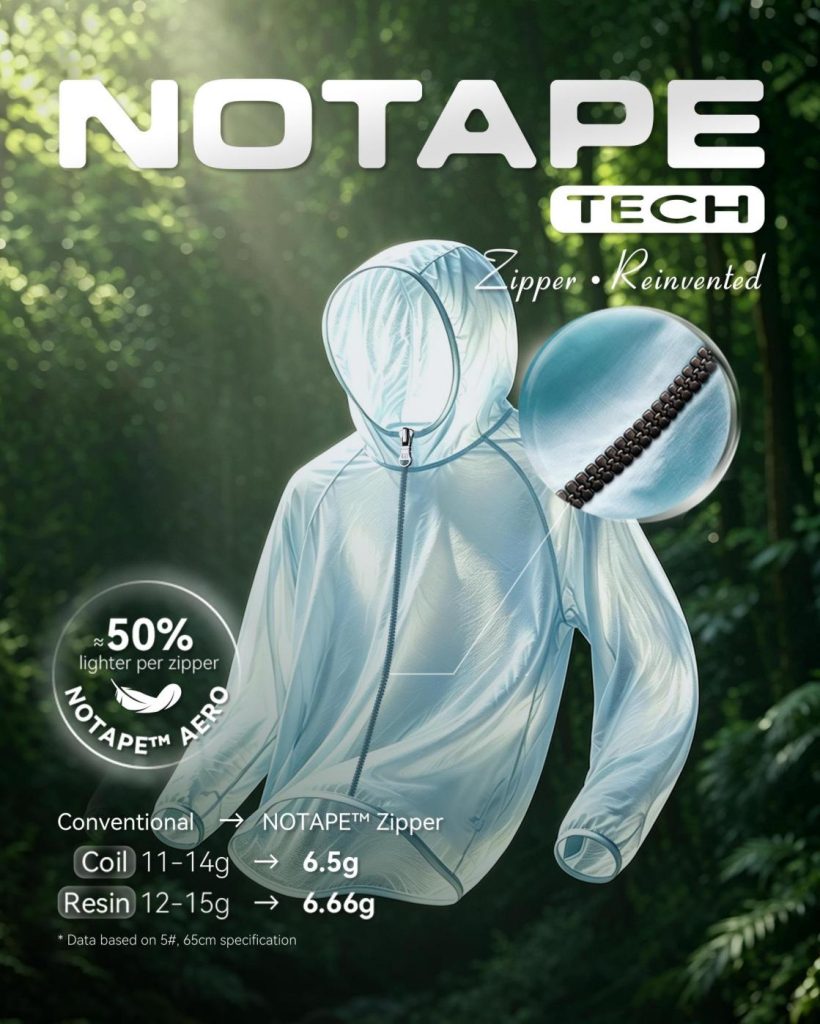
At NOTAPE™, we use a #5 zipper at 65 cm as a reference configuration to illustrate how structural simplification can affect zipper weight. In our comparison, a conventional coil zipper weighs approximately 11–14 g, while the NOTAPE™ No Tape coil configuration is about 6.5 g. For resin zipper construction, the conventional configuration is approximately 12–15 g, compared with about 6.66 g for the NOTAPE™ design.
These figures should not be interpreted as universal weight values for every Lightweight Technical Zipper. Actual zipper weight varies with zipper length, size, slider configuration, end components and garment application. At NOTAPE™, we therefore use these figures as a configuration-specific comparison to demonstrate how removing conventional zipper tape can reduce material weight without simply downsizing essential closure components.
The important engineering point is that the weight reduction comes from structural simplification rather than simply removing essential zipper functions.
How Should Brands Validate a Lightweight Technical Zipper?
Before production, brands should follow a complete evaluation chain:
Fabric Selection → Zipper Specification → Garment Sample → Dynamic Fit Test → Durability Test → Production Validation
When comparing suppliers, useful questions include:
•What zipper length and size is the quoted weight based on?
•Which structural component creates the weight saving?
•How does the zipper behave with the target fabric GSM?
•Has the structure been tested with stretch fabrics?
•Does installation require a different manufacturing process?
•What washing and cycling data are available?
•Is the stated performance based on the zipper alone or the finished garment?
Supplier specifications are useful, but they cannot replace finished-garment validation.
Choosing Lightweight Without Over-Simplifying the Decision
A Lightweight Technical Zipper should not be selected only because it has the lowest gram value. The better question is whether its mass, flexibility, attachment structure and durability are appropriate for the garment around it.
For lightweight sportswear and outdoor apparel, reducing unnecessary structural layers can be particularly valuable because it addresses both component mass and localized construction bulk.
For apparel teams exploring this approach, NOTAPE™ provides a different route based on eliminating conventional zipper tape rather than simply downsizing essential closure components. Designers and product developers can explore the technology at NOTAPE™ and evaluate how its No Tape structure fits their own fabrics, garment geometry and production requirements.
Q1: How is the pricing of NOTAPE™ zippers?
NOTAPE™ is positioned as a premium solution.
Higher cost reflects the innovation and technology involved.
Q2: Are there requirements regarding fabric type or thickness when using NOTAPE™ zippers?
Currently, NOTAPE™ technology is more suitable for synthetic fibers such as nylon and polyester, as well as woven, knitted, low-elastic, or non-elastic fabrics.
The applicability of other materials is still under development and testing.
Q3: What makes NOTAPE™ zippers uniquely different?
we come at a premium — because true innovation is rare. NOTAPE™ is not available to every brand. By integrating our no tape zipper technology, your products gain a level of exclusivity and uniqueness that sets them apart.
Q4: Which country is NOTAPE™ from?
NOTAPE™ was founded in Hong Kong and serves clients globally.
Q5: What kind of brand is NOTAPE™?
NOTAPE™ was founded in Hong Kong and is a technology-driven brand serving the global market, with a focus on innovative zipper technologies.



Contact Us
In This Article
Related Posts
How Should Brands Evaluate Zipper Performance for High-End Outdoor Clothing?
November 17, 2026
Notape pitches lighter repairable zippers
November 16, 2026
130 Years Later, Cars Were Reinvented by Electrification. What About the Zipper?
October 12, 2026
Waterproof Zipper without Coating Supplier | NOTAPE™ No Coating Zipper Technology
September 26, 2026


