




Sustainable Zipper Technology: A Guide to Materials and Manufacturing

Related Posts
How Should Brands Evaluate Zipper Performance for High-End Outdoor Clothing?
November 17, 2026
Notape pitches lighter repairable zippers
November 16, 2026
130 Years Later, Cars Were Reinvented by Electrification. What About the Zipper?
October 12, 2026
Waterproof Zipper without Coating Supplier | NOTAPE™ No Coating Zipper Technology
September 26, 2026
Sustainable Zipper Technology: Materials and Manufacturing
When brands review the sustainability of a garment, they look at two main things: what it is made of and how it is made. The same applies to the zipper. Its materials and its manufacturing method both shape its role in a responsible product.
Zippers are found on many garments, often more than once. Across a full collection, the materials used in zippers and the way zippers are attached add up.
What Innovation Means for Sustainable Zipper Technology
Innovation is led by creativity. Thinking out of the box. So, innovation is actually a practical implementation of ideas that results in the introduction of new goods. And innovation is also like continuous improvement. It always starts with curiosity. From curiosity, it goes into ideas. From ideas, it goes into products and finally goods to sell.
Innovation is very important because it is a catalyst for growth. Without innovation, brands wouldn’t be able to anticipate and fulfill future customer needs ahead of time.
The aim is finally to work on products for a better world, a better community, because this gets the community involved, and finally, better business. The reputation in the world as a leader is based on being innovative as a solution provider. A supplier of the latest and best technologies with perfect quality. Products and services in innovation are more critical even in rapidly growing markets.
Three Directions for Sustainable Zipper Materials
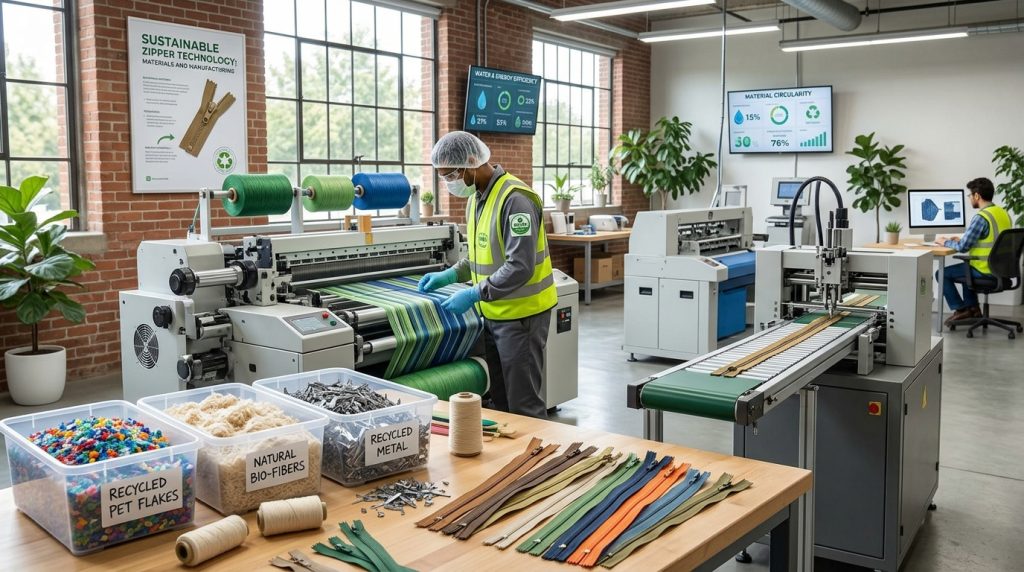
The industry is focused on three major directions: recycled products, circularity, and sustainable sources.
Recycling uses different technologies, like recycling selected color materials, reducing water impact and chemicals. Circularity means checking the life cycle of materials. Then there are renewable sources and natural sources under the sustainability aspect, like using natural fibers, hemp fiber, soybean protein fiber, just as an example. And then the third part is finally C2C, which means cradle-to-cradle, which is the end stage of life cycling, going into biodegradation.
Sustainable Zipper Materials in Detail
Recycled Polyester
It’s recycled. It’s repurposed. It’s repeat. So 100% recycled polyester is used. Recycled polyester comes from PET bottles. So, recycled water bottles. They are sorted, collected, and cleaned before being ground into flakes, melted down, extruded into fiber, and then used, remade from water bottles.
Very important is delivering the same level of performance compared to virgin materials. These eco-friendly materials help to reduce the impact of using virgin materials.
Dissolvable Threads and Circularity
Circularity is a big focus for the industry at the moment. It’s a water-dissolvable thread that allows the garment to be disassembled at the end of its life cycle. It’s a very important step. A certain material called PVA is used, together with cotton in construction, to knit or weave fabrics, like denim, which is finally fully biodegradable. At the end of the denim’s life, it will last probably 40 to 50 domestic washes. Then it can be dismantled and recycled and reused.
If you imagine how small the stitching thread is by weight compared to denim, for example, but how important it is. The dissolvable thread makes it possible to dismantle the denim. So, without this process, it’s not possible to reuse. This small step supports the idea of dismantling. This is key to circularity in terms of reusing and recycling an entire denim after its life cycle. It shows how important circularity is to innovation.
To be part of such a widespread cycle, where logistically brands, consumer, manufacturer all are involved, is a very important step. From recycling to reuse to circularity in the entire process of fabrics.
Lyocell: A Regenerated Fiber
Lyocell is very eco-friendly. It’s a regenerated fiber. It’s fully biodegradable and compostable because it’s made from wood pulp. And wood pulp means it’s of cellulosic origin. This nature-based product with superior elongation, outstanding comfort, and perfect touch and hand feel is ideal for next-to-skin applications. It doesn’t irritate any kind of skin-to-skin contact.
And it helps even to reduce the carbon footprint, because cellulose fiber is carbon neutral and it’s made from 100% controlled wood during harvesting. The processing is a so-called closed-loop manufacturing process, with 99% solvent recovery. Not any emission or effluent is going into the air.
Hemp: A Natural Fiber
A fiber blend using hemp fiber and lyocell has been created. Hemp comes from the inner fiber of the plant, the stalk. It’s a warm fiber, a breathable fiber. It’s moisture-wicking and antibacterial. So, this is absolutely a natural fiber.
It helps the farmer during cultivation and harvesting. It’s easy to process and manufacture because it’s water-saving. It grows two to three times more on an acre of land than other natural fibers. Very important: no pesticides or fertilizer are required. The growth of hemp fiber reduces even CO2 emissions.
This one has been worked on with spinning mills, with a fiber association, on sourcing, even up to the farmer, to see and highlight the benefits of hemp itself. And it leads to a final product with perfect benefits. Benefits in many directions. All parts, from the growth to the manufacturing to the knitter, have to work together to promote such a project. So, you can imagine the steps in producing this fiber: dew retting, degumming, cottonizing; everything has an impact. It makes this project very sustainable and very innovative.
It’s easy to explain why. It’s a combination. The source of the product is a natural fiber, organic fiber, combined with a sustainable regenerated fiber, Lyocell. So, this has an impact on the environment. The combination involves technical issues in synthesis with social aspects. The farmer does not need to use fertilizer or herbicides. It’s definitely a very positive, eco-friendly step during the growth. The effectiveness of the soil, instead of using chemical fertilizer, has a positive impact on the footprint.
How Sustainable Zipper Manufacturing Ideas are Found
It’s a continuous process of investigation. Investigating is a way of collecting market insights: visiting exhibitions, being in very close contact with brands, listening to their strategy and their goals, attending webinars, workshops, reading network news, and inviting people to brainstorm. To share their ideas. To share their goals for future projects. Inviting universities, startups, customers, manufacturers, and material suppliers. So, everyone has an idea.
Excitement is always the nice part of describing innovation. It’s a lot of work. The industry is working on all kinds of aspects to meet the demand of the market. This is the role of pioneers, seeking solutions ahead of the demand. The goal is to be ready.
NOTAPE™: Sustainable Zipper Technology in Materials and Manufacturing
With NOTAPE™, the textile tape is removed entirely. The zipper teeth integrate directly with the garment fabric. With NOTAPE™, the zipper is formed as one with the fabric using patented equipment, rather than traditional sewing methods. NOTAPE™ removes the zipper tape from the materials list and replaces sewing the zipper on with a patented forming process.
The damage rate for NOTAPE™ coil zippers is extremely low. A full sustainability assessment also looks at the main fabric, production, use, and end of life. Brands should support wider claims with data.
A Never-Ending Journey
It’s a never-ending journey. Circularity is not just a fashion topic. It’s a part of strategy.
Contact NOTAPE™ to explore tape-free zipper technology for your next collection.



Contact Us
In This Article
Related Posts
How Should Brands Evaluate Zipper Performance for High-End Outdoor Clothing?
November 17, 2026
Notape pitches lighter repairable zippers
November 16, 2026
130 Years Later, Cars Were Reinvented by Electrification. What About the Zipper?
October 12, 2026
Waterproof Zipper without Coating Supplier | NOTAPE™ No Coating Zipper Technology
September 26, 2026


