




NOTAPE™ AERO Ultra-Lightweight Zipper: What Changes at 50% Less Weight for Apparel Design?
By hqt
08, 2026Related Posts
130 Years Later, Cars Were Reinvented by Electrification. What About the Zipper?
October 12, 2026
Waterproof Zipper without Coating Supplier | NOTAPE™ No Coating Zipper Technology
September 26, 2026
From No Tape to Water Resistance Without Coating: NOTAPE™ Rethinks the Zipper Through Its “Three-No” Design
September 14, 2026

NOTAPE™Returns to Intertextile Shanghai Apparel Fabrics with Groundbreaking NO TAPE, NO SEAM, NO COATING Zipper Innovation
August 06, 2026
When developing a lightweight skin jacket, most apparel teams begin with the fabric.
They compare fabric weight, yarn structure, breathability, wind resistance, softness, and packability. A reduction of just a few grams per square meter may require repeated material testing and multiple rounds of sampling.
However, one component is often overlooked: the zipper.
A conventional zipper may account for only a small proportion of the garment, but on a lightweight skin jacket, cycling jacket, sun-protective garment, or packable outdoor layer, several grams can make a noticeable difference.
The NOTAPE™ AERO Ultra-Lightweight Zipper approaches lightweight apparel design from this frequently ignored detail.
How Much Weight Can a Zipper Actually Save?
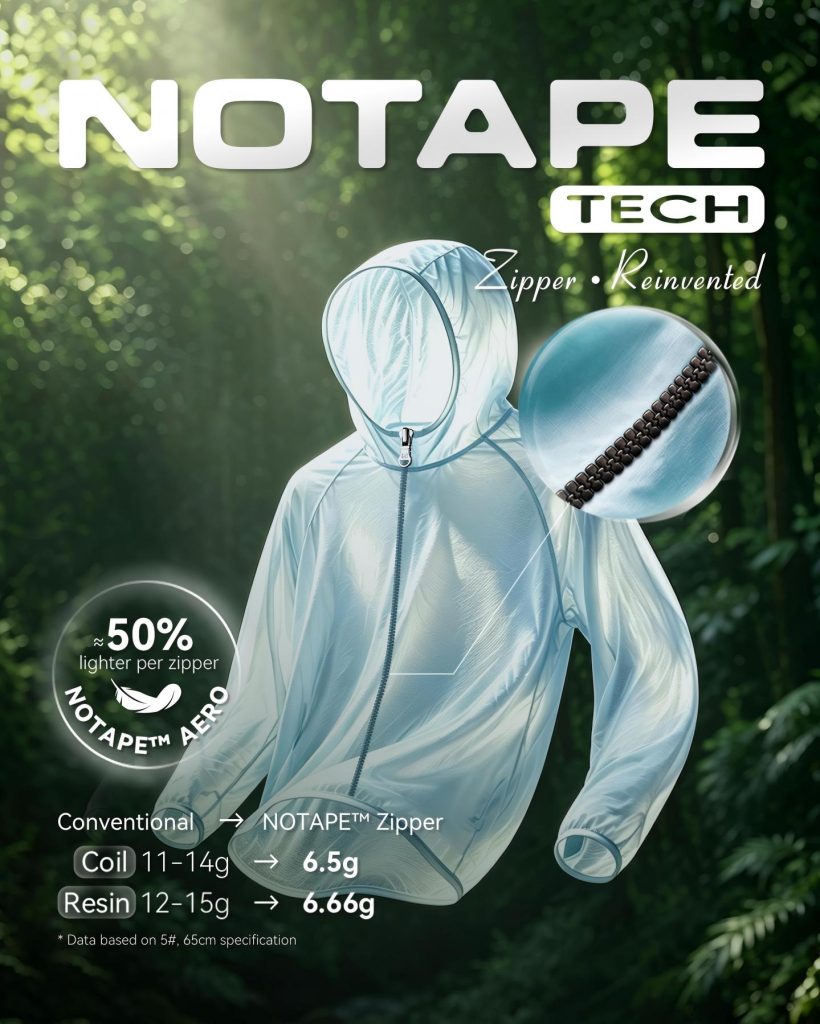
Take a #5 zipper with a length of 65 cm as an example.
| Zipper Category | Conventional Zipper | NOTAPE™ No Tape Zipper |
| Coil Zipper | 11–14 g | 6.5 g |
| Resin Zipper | 12–15 g | 6.66 g |
| Approximate Weight Reduction | — | Nearly 50% per zipper |
The above data are based on #5, 65 cm zipper specifications. Actual weight may vary according to zipper length, slider configuration, garment fabric, and application requirements.
For a conventional Coil Zipper weighing between 11 and 14 grams, the NOTAPE™ AERO alternative weighs approximately 6.5 grams.
For a conventional Resin Zipper weighing between 12 and 15 grams, the corresponding NOTAPE™ No Tape Zipper weighs approximately 6.66 grams.
This means that one zipper can be nearly 50% lighter under the stated comparison conditions.
In ordinary apparel, a difference of several grams may appear minor. In ultralight clothing, however, every component is part of the total weight target.
Why Several Grams Matter in a Skin Jacket
A lightweight skin jacket is often expected to provide protection while remaining barely noticeable during wear. Its value comes from being easy to carry, easy to pack, and comfortable during movement.
When the fabric has already been reduced to a very low weight, the zipper becomes a larger proportion of the overall garment.
For example, apparel developers may spend considerable time reducing fabric weight by two or three grams per square meter. Yet a lighter zipper can remove several grams from one concentrated area of the garment.
This makes the NOTAPE™ AERO Lightweight Zipper relevant to applications such as:
•Lightweight skin jackets
•Sun-protective jackets
•Packable wind jackets
•Running and training apparel
•Cycling apparel
•Lightweight outdoor layers
•Casual performance garments
The value is not simply that the zipper is lighter. It is that the weight reduction is achieved in a component positioned along the center front, where heaviness and stiffness can directly affect how the garment feels.
What Changes When the Zipper Is Nearly 50% Lighter?
A More Balanced Garment Structure
A very light fabric combined with a relatively heavy zipper can create an imbalance. The front closure may sag while adjacent panels soft and flexible.
A zipper of lower weight helps the closure function better with lightweight textile panels.
The garment may feel less front heavy, especially during activities like running, cycling or hiking, where there is continuous movement.
Less Concentrated Weight at the Center Front
The zipper is usually one of the longest continuous components on a jacket. Even when its total weight seems limited, that weight is concentrated in a narrow vertical area.
A lighter zipper can reduce this localized load.
For skin jackets and sun-protective clothing, this may help the front panel sit more evenly against the body rather than feeling noticeably heavier than the back or sleeves.
Better Support for Packable Apparel
Many lightweight jackets are designed to fold into a pocket or compact storage pouch.
In this type of product, every gram contributes to the final packed weight. The zipper is also positioned along the main folding line, making it an important consideration in compact garment design.
By using the NOTAPE™ AERO Ultra-Lightweight Zipper, designers can reduce zipper weight without relying only on thinner fabrics.
More Freedom in Fabric Selection
Lightweight fabrics are becoming softer, thinner, and more flexible. The contrast in weight between fabric and zipper can become increasingly apparent when used alongside a traditional zipper.
The incorporation of the lightweight Technology Zipper gives designers the flexibility to use low-density and ultra-low-density woven, lightweight synthetics, and packable materials.
Instead of selecting a heavier fabric simply to support the zipper, apparel teams can evaluate the closure and fabric as one integrated weight system.
Lightweight Design Is More Than Fabric Weight
Garment lightweighting is sometimes reduced to a single fabric specification, such as grams per square meter. In practice, the finished weight depends on the complete bill of materials.
This includes:
•Main fabric
•Lining or pocket fabric
•Thread
•Elastic
•Drawcords
•Labels
•Stoppers and adjusters
•Zippers and sliders
When these components are considered separately, the zipper may seem insignificant. When they are evaluated together, it becomes clear that trim selection can either support or weaken the lightweight objective.
The NOTAPE™ AERO Lightweight Zipper gives apparel developers another area in which weight can be reduced without placing the entire burden on fabric engineering.
The Next Few Grams May Be Hidden in the Zipper
For lightweight apparel, the easiest weight reductions are often completed first. Fabrics become thinner, accessories become smaller, and unnecessary layers are removed.
After that, further progress requires closer attention to details.
For one garment, the difference may be several grams. Across an entire lightweight collection, it becomes part of a more systematic product strategy.
When apparel designers want to make a skin jacket lighter, the answer may not always be another lighter fabric.
Sometimes, the overlooked detail is the zipper.
FAQs
Q1: What is the difference between NOTAPE SEAL and other water-resistant zippers?
While conventional water-resistant zippers rely on laminated coatings, NOTAPE™ SEAL features a revolutionary No Tape, No Seam, No Coating design. Instead of using a coating, its water-resistant performance is achieved entirely through precision-engineered physical structure.
Q2: Does NOTAPE™ SEAL provide the same level of water protection as conventional waterproof zippers? How waterproof is it?
NOTAPE™ is the world’s first tapeless, seamless and water-resistant zipper without coating, so there is currently no dedicated testing standard for this type of zipper. As a result, its performance is assessed using the same industry test methods applied to conventional water-resistant zippers.
Independent testing by ITS and SGS confirms that the NOTAPE™ SEAL series meets the water-resistant performance requirements of internationally recognized European, American, and Chinese industry standards.
Q3: Are NOTAPE™ zippers water-resistant in rainy or heavy rain conditions?
Yes, NOTAPE provides a range of water protection solutions tailored to different garment applications and performance requirements. Depending on the end-use scenario, customers can choose from water-repellent solutions to higher-level water-resistant solutions.
Q4: How are the zipper top stop and bottom stop handled?
The zipper structure is formed using patented equipment and specialized process treatments.



Contact Us
In This Article
Related Posts
130 Years Later, Cars Were Reinvented by Electrification. What About the Zipper?
October 12, 2026
Waterproof Zipper without Coating Supplier | NOTAPE™ No Coating Zipper Technology
September 26, 2026
From No Tape to Water Resistance Without Coating: NOTAPE™ Rethinks the Zipper Through Its “Three-No” Design
September 14, 2026
NOTAPE™Returns to Intertextile Shanghai Apparel Fabrics with Groundbreaking NO TAPE, NO SEAM, NO COATING Zipper Innovation
August 06, 2026


