




Performance Zipper Durability: What Happens After Washing, Abrasion and Repeated Cycling?
By hqt
10, 2026Related Posts
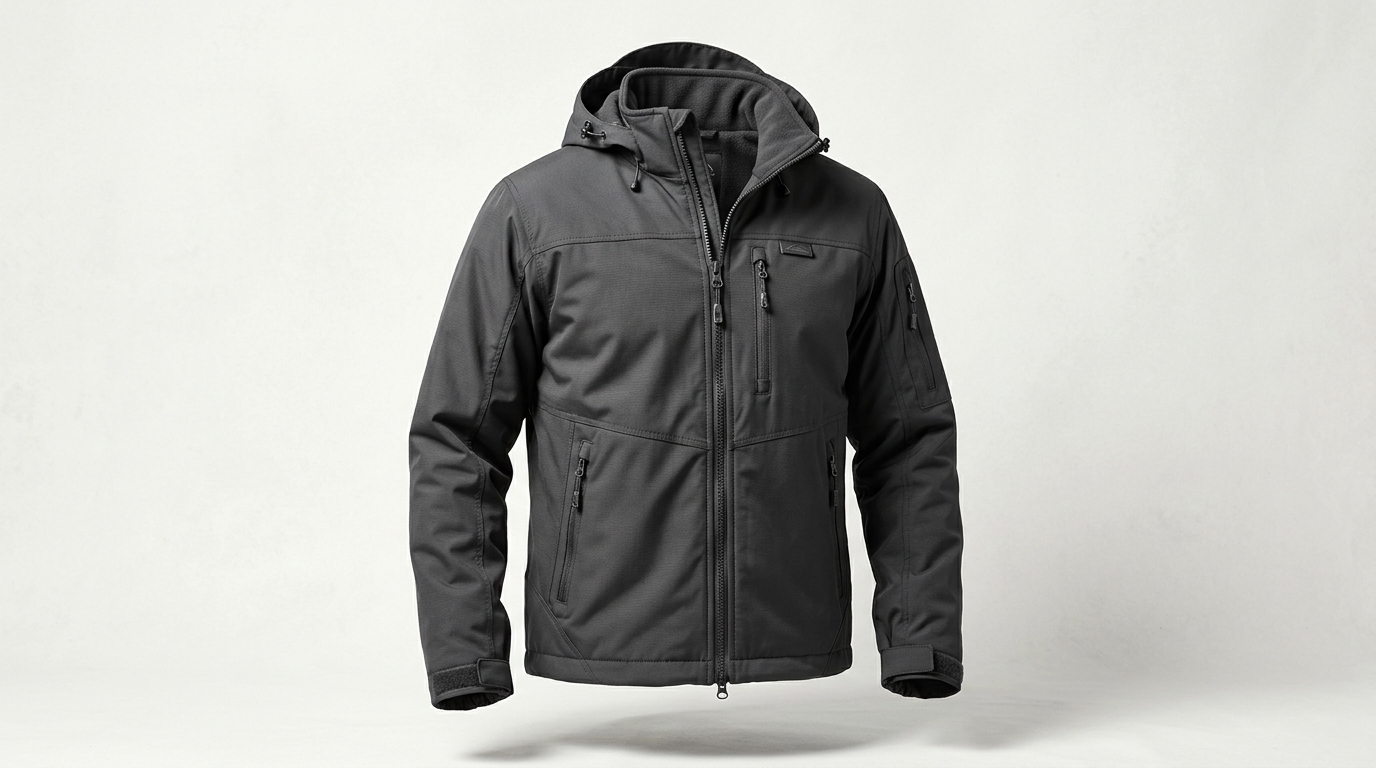
How Should Brands Evaluate Zipper Performance for High-End Outdoor Clothing?
November 17, 2026
Notape pitches lighter repairable zippers
November 16, 2026
130 Years Later, Cars Were Reinvented by Electrification. What About the Zipper?
October 12, 2026
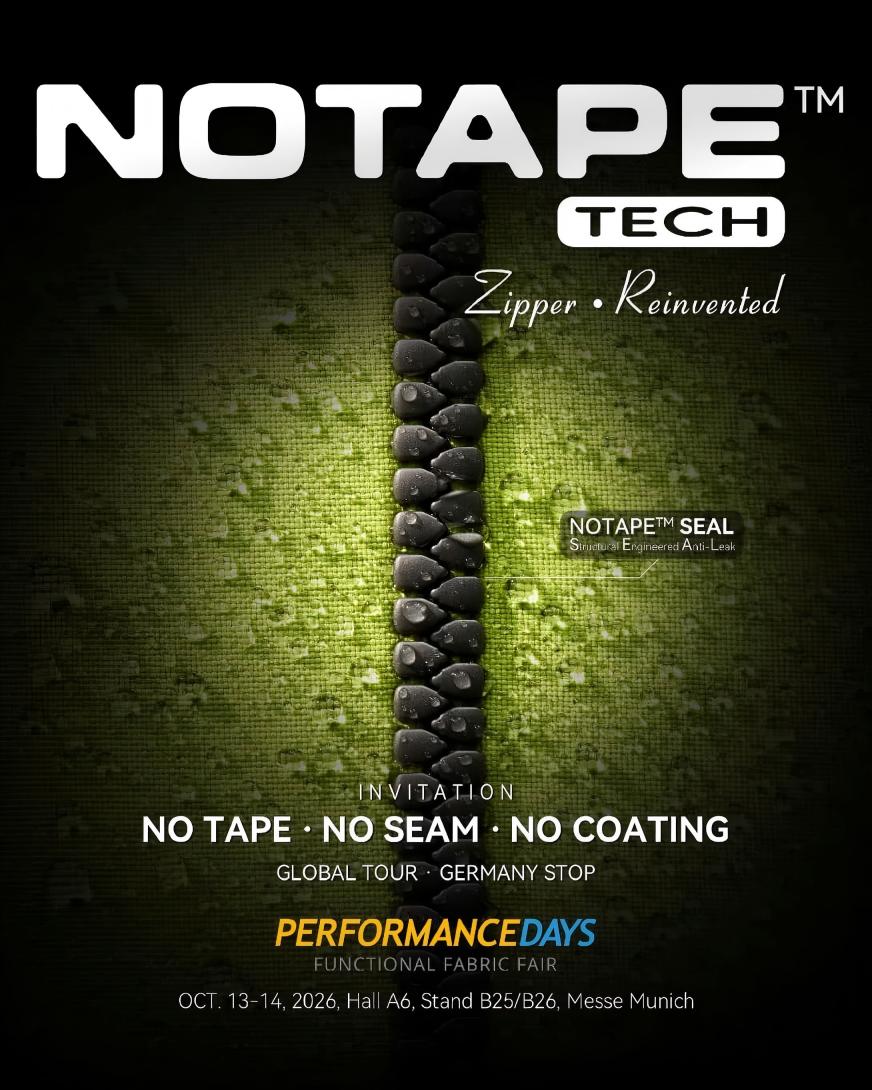
Waterproof Zipper without Coating Supplier | NOTAPE™ No Coating Zipper Technology
September 26, 2026
A Performance Zipper should not be judged only by how strong it is when new. For technical apparel, the more useful question is: how much function remains after repeated washing, surface abrasion and thousands of opening-and-closing movements?
A zipper may retain its basic shape yet become harder to operate, lose alignment, show surface wear or experience changes at the zipper-fabric interface. This is why durability testing should evaluate retained performance, not only initial strength.
What Does Durability Mean for a Performance Zipper?
We evaluate the durability of our Performance Zipper in several ways.
1. Mechanical strength: Includes chain separation, slider loading, and stop failure.
2. Operability: Includes the slider’s ability to open and close the zipper.
3. Structural stability: Includes the alignment of the zipper coils and teeth and the alignment of the slider and attachment points.
4. Functional retention: Includes aged properties of the zipper, for example, the zipper remains water resistant.
ASTM D2061 covers several zipper strength properties. ASTM D2062 covers zipper operability. An important point in the ASTM Guides is that individual tests will not assess every property required for satisfactory zipper performance.
For buyers, this means a single breaking-strength number is rarely enough.
A better comparison is:
Initial Performance → Controlled Aging → Post-Aging Performance → Failure Inspection
What Happens After Repeated Washing?
Washing exposes a Performance Zipper to several stresses simultaneously:
Water + Detergent + Temperature + Tumbling + Bending
These conditions can affect different zipper constructions in different ways.
| Washing Variable | Possible Effect |
| Detergent and water | Interaction with finishes and surface treatments |
| Temperature | Dimensional or material changes |
| Tumbling | Repeated impact and bending |
| Drying | Additional thermal and mechanical stress |
| Repeated cycles | Accumulated wear at interfaces |
ASTM D2051 specifically addresses the durability of zipper finishes to laundering, illustrating why washing should be treated as its own aging mechanism rather than simply another tensile-strength test.
For coated or laminated water-resistant zippers, developers should also determine whether laundering changes the functional surface—not merely whether the zipper still opens.
How Does Abrasion Change Performance Zipper Behavior?
Abrasion occurs wherever surfaces repeatedly contact each other. Typical areas include:
•Slider-to-element contact;
•Garment panels rubbing against the zipper;
•Backpack straps crossing a front zipper;
•Pocket openings exposed to frequent handling;
•External surfaces on outdoor apparel.
•It is useful to distinguish surface durability from structural durability.
A worn surface does not automatically mean the zipper chain has failed. However, when a functional property depends on that surface—for example, a coating contributing to water resistance—surface deterioration may become a performance issue before mechanical failure occurs.
This is why a Performance Zipper should be inspected after abrasion for more than visible damage. Operating force, chain engagement, surface condition and functional performance should also be checked.
What Happens After Thousands of Opening and Closing Cycles?
Repeated cycling primarily creates mechanical fatigue and friction.
The progression may look like this:
Repeated Sliding → Frictional Wear → Tolerance Changes → Altered Engagement → Higher Operating Force Or Instability
The slider is particularly important because it controls how the two sides of the chain engage and separate. Wear or deformation can change the interaction between slider and elements even when neither component has completely broken.
Possible cycling-related failure modes include:
| Failure Mode | Possible Cause |
| Increasing operating force | Friction, contamination or component wear |
| Chain separation | Poor element engagement |
| Slider looseness | Mechanical wear or deformation |
| Element damage | Repeated local loading |
| Stop failure | Repeated impact at travel limits |
A Performance Zipper therefore should not be described as durable simply because it survives a specified number of cycles. Buyers should also ask how it operates after those cycles.
Why Combined Aging Gives a More Realistic Picture
Real garments do not experience washing, abrasion and cycling separately.
A shell jacket may be washed, folded, worn under a backpack, opened repeatedly and exposed to moisture—all within the same service life.
A more informative evaluation sequence is:
Baseline Test → Washing/Abrasion/Cycling → Functional Test → Strength Test → Visual Inspection
This reveals whether performance is being retained as the zipper ages.
It also explains why garment-level testing matters. Laboratory testing of the zipper alone cannot fully reproduce stresses created by fabric stiffness, garment geometry or local loading.
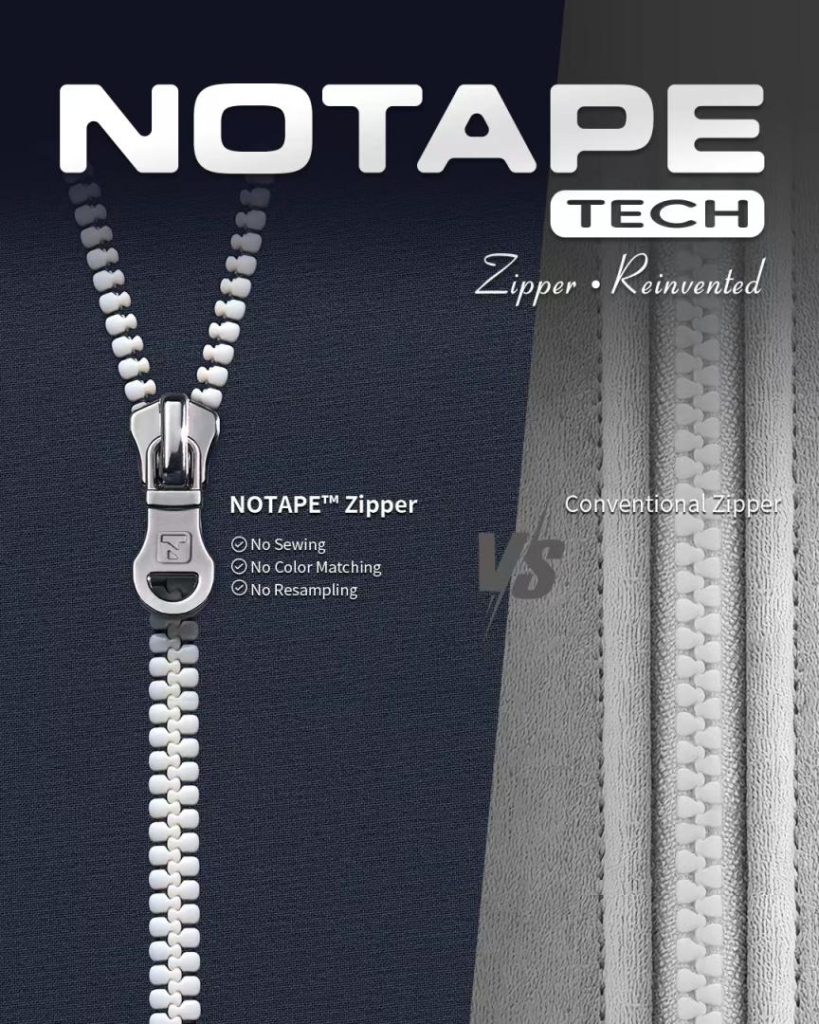
Conventional vs Tape-Free Performance Zipper Construction
Construction architecture influences which interfaces are exposed to long-term aging.
A conventional zipper typically follows:
Elements → Textile Tape → Sewing → Garment Fabric
NOTAPE™ takes a different structural route by removing the traditional zipper tape and integrating the zipper structure more directly with compatible garment fabric. Its No Tape, No Seam resin construction removes both the separate tape and conventional tape-sewing line.
| Structural Factor | Conventional Zipper | NOTAPE™ Approach |
| Separate textile tape | Required | Removed |
| Connection | Tape attached to garment | More direct fabric integration |
| Material interfaces | More layered | Fewer structural layers |
| Tape color matching | Required | Eliminated |
| Durability focus | Chain, tape, seam and surface layers | Chain, fabric integration and operating components |
This does not mean that removing tape automatically guarantees greater durability. It changes the durability equation by reducing certain structural layers and shifting attention toward element-fabric integration, fabric compatibility and post-aging stability.
Water Resistance: Surface Treatment vs Structural Design
Water-resistant Performance Zipper development introduces another variable: how water resistance is created.
Conventional solutions commonly use textile tape combined with a coating or film. Repeated folding, washing and abrasion therefore make the condition of that functional layer relevant.
NOTAPE™ SEAL follows a No Tape, No Seam, No Coating concept. According to NOTAPE™, its water-resistant approach removes the conventional textile tape, the tape-sewing line and dependence on a surface coating.
For engineers, the important question is not which architecture sounds simpler. It is which architecture retains the required performance after the intended aging conditions.
How Should Buyers Evaluate Performance Zipper Durability?
Before approving a Performance Zipper, sourcing and development teams should ask:
•Which test standard and test conditions were used?
•Were results measured before or after aging?
•How many washing and cycling stages were included?
•Was abrasion evaluated?
•Was operating force checked after cycling?
•Were strength and alignment retested after aging?
•Was water resistance measured before and after aging where relevant?
•Which garment fabric was used?
•Was the complete zipper-fabric system tested?
The application also matters. A lightweight running jacket prioritizes low mass and repeated operation differently from a ski shell exposed to abrasion, moisture and cold conditions.
There is therefore no universally “most durable” Performance Zipper. A more defensible selection process is:
Application Load → Aging Environment → Required Function → Zipper Structure → Verification Method
Durability Starts with the Structure You Test
A meaningful Performance Zipper specification should describe what remains after use—not simply what the zipper can achieve when new. Washing challenges finishes and interfaces, abrasion attacks exposed surfaces, and repeated cycling tests the mechanical relationship between slider and chain.
For apparel developers exploring a different structural route, NOTAPE™ offers tape-free zipper technologies that reduce conventional zipper layers and integrate the closure more directly with compatible garment fabrics. Rather than assuming any structure is automatically superior, the practical next step is to evaluate it against the actual fabric, garment construction and durability requirements of the application.
Explore NOTAPE™ zipper technology and discuss how a tape-free Performance Zipper can be tested for your specific apparel development requirements.
FAQs
Q1. What is a NOTAPE™ Performance Zipper?
A NOTAPE™ zipper removes the conventional textile zipper tape and integrates the zipper structure more directly with compatible garment fabric.
Q2. How is NOTAPE™ different from a conventional zipper?
Conventional zippers typically use elements, textile tape and sewing. NOTAPE™ removes the separate textile tape from the construction.
Q3. Does a tape-free zipper automatically have better durability?
No. Durability still depends on fabric compatibility, zipper construction, application loads and post-aging test results.
Q4. What should be tested when evaluating NOTAPE™ durability?
Key checks include chain strength, slider operation, repeated cycling, washing, abrasion, fabric integration and post-aging stability.
Q5. Can NOTAPE™ be used for water-resistant apparel?
NOTAPE™ offers water-resistant zipper solutions designed around structural integration rather than relying only on traditional taped constructions.



Contact Us
In This Article
Related Posts
How Should Brands Evaluate Zipper Performance for High-End Outdoor Clothing?
November 17, 2026
Notape pitches lighter repairable zippers
November 16, 2026
130 Years Later, Cars Were Reinvented by Electrification. What About the Zipper?
October 12, 2026
Waterproof Zipper without Coating Supplier | NOTAPE™ No Coating Zipper Technology
September 26, 2026


