




How a Sustainable Zipper Manufacturer Supports the Circular Fashion Economy
By hqt
11, 2026Related Posts
How Should Brands Evaluate Zipper Performance for High-End Outdoor Clothing?
November 17, 2026
Notape pitches lighter repairable zippers
November 16, 2026
130 Years Later, Cars Were Reinvented by Electrification. What About the Zipper?
October 12, 2026
Waterproof Zipper without Coating Supplier | NOTAPE™ No Coating Zipper Technology
September 26, 2026
A jacket can remain structurally sound but become difficult to wear when its zipper fails. And before that zipper reaches the garment, its textile tape has already been spun, woven, dyed and finished. These are two distinct circular-design questions: How much material does the closure require, and how long can the garment remain in service?
At NOTAPE™, we approach both questions through zipper construction. A Sustainable Zipper Manufacturer should be able to explain not only what a component contains, but why each layer is there.
What Does Circular Fashion Require from a Zipper?
Circular fashion is more demanding than substituting recycled yarn. It aims to prevent waste, keep products in use and recover material value.
Zippers define four design criteria:
1. Material efficiency: Minimize carrier, coating and processing inputs.
2. Service life: Retain function and reliability of fastening throughout use (e.g. opening cycles, laundering, wear, etc.)
3. Repair: Determine if failed slider/tooth allows function to be restored without replacing the entire item.
4. End-of-life: Determine how closure and textile can be separated and processed.
These four design criteria must be addressed in unison; an ultra-light weight zipper doesn’t necessarily make a closure system more circular.
Why Does Traditional Zipper Construction Matter?
A conventional zipper is built around a textile tape that carries the interlocking elements. The tape is typically manufactured and dyed separately, then sewn to the garment. Depending on the application, a water-resistant version may also incorporate a laminated film or coating.
Those layers serve established functions, but they also introduce:
•Yarn, weaving and dyeing requirements for the tape;
•Tape colour matching and additional stock-keeping;
•A sewn interface, which can add bulk to lightweight fabric;
•Additional materials that must be considered during disassembly.
For a Sustainable Zipper Manufacturer, the question is whether the required function can be delivered with fewer intermediate layers.
How Does a Sustainable Zipper Manufacturer Redesign the Closure?
1. Remove the Separate Tape—Not the Essential Fastening Parts
NOTAPE™ integrates the zipper structure with the garment fabric instead of using conventional textile tape as a carrier. Teeth, sliders and stops remain necessary; the change is in how the chain connects to the garment.
Our product routes differ:
| Engineering Dimension | Conventional Construction | NOTAPE™ Approach |
| Tooth carrier | Separate textile tape | No Tape: direct fabric integration |
| Garment attachment | Tape typically sewn to panel | Coil: tape-free with appropriate sewing; resin: No Tape, No Seam configuration |
| Water resistance | Often film/coating on tape | NOTAPE™ SEAL: structural water resistance without conventional tape coating |
Repair potential]Depends on component and installation]Individual resin teeth can be repaired in applicable designs; coil teeth are not individually repairable
Recycling]Materials and attachment must be assessed]Still requires end-of-life assessment; no automatic recyclability claim
2. Quantify Manufacturing Inputs
Removing tape avoids its associated weaving, dyeing and finishing stages. It does not mean the entire zipper manufacturing system consumes no water or energy.
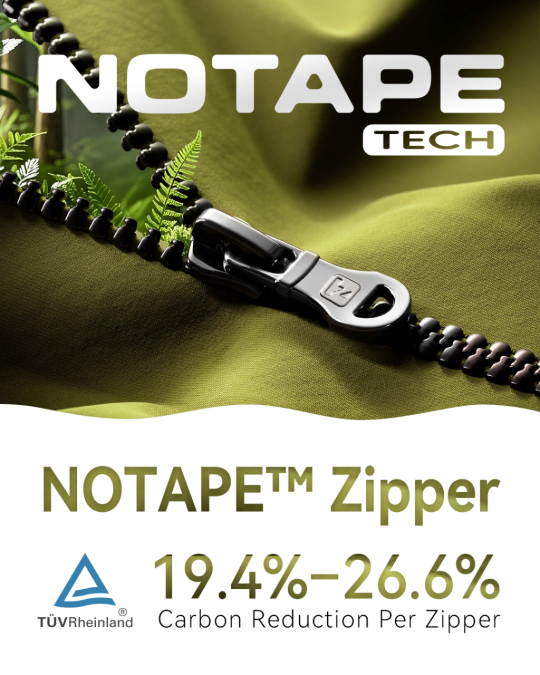
NOTAPE™ reports 19.4%–26.6% lower comparative carbon footprints for assessed coil and resin zipper configurations, based on TÜV-evaluated data using ISO 14067 methodology. For the same comparison, reported reductions in water use differ by zipper type: 45% for coil and 95% for resin.
These are configuration-specific findings. A credible Sustainable Zipper Manufacturer should disclose the reference zipper, functional unit, system boundary and assumptions before using these figures in garment-level reporting.
3. Test Durability at the Fabric–Zipper Interface
Removing tape changes load transfer. The fabric and zipper attachment must withstand repeated slider movement, lateral tension and laundering without distortion or element detachment.
For development teams, relevant checks include:
•Chain crosswise strength and slider operation;
• Attachment integrity under tensile loading;
•Dimensional change after washing;
•Flexing and abrasion at the closure edge;
•Water penetration before and after laundering, where applicable.
NOTAPE™ recommends fabric validation before production. Thickness, stretch, surface finish and fibre composition can affect compatibility; polyester and nylon constructions are among the current focus materials.
4. Treat Repair and Recycling as Separate Issues
Repairability postpones disposal; recyclability concerns what happens when use finally ends. NOTAPE™ offers individual-tooth repair for applicable resin/plastic zipper designs, but not for coil zipper teeth.
A tape-free assembly removes one textile layer, but direct integration does not guarantee easy disassembly. Recycling outcomes depend on the full garment architecture and available local processing.
How Should Brands Evaluate a Sustainable Zipper Manufacturer?
Before selecting a closure, request evidence in four areas:
•Construction drawings: Which tape, stitches or coatings are actually eliminated?
•Application testing: What fabric, wash cycle, closure load and weather exposure were tested?
•Comparable environmental data: Are both options assessed at the same zipper size and functional specification?
•Maintenance and recovery: Which parts are repairable, and how does the zipper affect garment disassembly?
Consider weight only with matching specifications. For example, NOTAPE™ reports a 65 cm, #5 coil zipper at approximately 6.5 g, compared with 11–14 g for specified conventional versions. That is a component-level comparison, not a prediction of whole-garment weight reduction.
Our Design Approach at NOTAPE™
At NOTAPE™, we remove the traditional tape, then evaluate what that change means for materials, attachment strength and garment use. Designers revisiting closure specifications can explore our tape-free technology and environmental data as a starting point.
FAQs
Q1: Can NOTAPE™ coil zippers be repaired?
No. Coil zippers cannot be repaired.
However, the damage rate for coil zippers is extremely low.
Q2: How is the pricing of NOTAPE™ zippers?
NOTAPE™ is positioned as a premium solution.
Higher cost reflects the innovation and technology involved.
Q3: How can NOTAPE™ zippers be purchased?
Will they be available to general consumers or individual buyers?
Q4: What types of garments can NOTAPE™ zippers be used for? Can they be used for bags, hats, or cases?
NOTAPE™ currently focuses on the high-end apparel segment, primarily covering down jackets, windbreakers, lightweight jackets, and business-formal garments.
If future application directions are updated, we will inform our partners in a timely manner and share relevant technical and application information accordingly.
Q5: How are the zipper top stop and bottom stop handled?
The zipper structure is formed using patented equipment and specialized process treatments.
Share on Social:



-
PREV:
Waterproof Zipper Without Coating for the Growing Urban Outdoor Fashion Market
- NEXT: Not NEXT
Contact Us
In This Article
Related Posts
How Should Brands Evaluate Zipper Performance for High-End Outdoor Clothing?
November 17, 2026
Notape pitches lighter repairable zippers
November 16, 2026
130 Years Later, Cars Were Reinvented by Electrification. What About the Zipper?
October 12, 2026
Waterproof Zipper without Coating Supplier | NOTAPE™ No Coating Zipper Technology
September 26, 2026


