




High Performance Zipper for Seamless and Lightweight Clothing
By hqt
11, 2026Related Posts
How Should Brands Evaluate Zipper Performance for High-End Outdoor Clothing?
November 17, 2026
Notape pitches lighter repairable zippers
November 16, 2026
130 Years Later, Cars Were Reinvented by Electrification. What About the Zipper?
October 12, 2026
Waterproof Zipper without Coating Supplier | NOTAPE™ No Coating Zipper Technology
September 26, 2026
A lightweight jacket may use thin, flexible fabric, yet its zipper area often feels noticeably thicker and stiffer. The reason is not always the zipper teeth—it is the construction surrounding them.
Conventional zippers need textile tapes, sewing, and sometimes laminates. All add bulk and affect a fabric’s natural movement.
For designers working with lightweight and seamless clothing, the High Performance Zipper raises an important question: Can closures keep mechanical integrity while eliminating redundant layers?
At NOTAPE™, instead of just changing materials, we use zipper architecture to address this.
1. What Defines a High Performance Zipper?
Zippers have many features that differ from traditional ones. Some of the special features include:
•Chain strength: Ability to withstand lateral forces that separate elements of a zipper.
•Operational durability: Slider’s ability to move freely throughout its cycle.
•Attachment strength : Resistance to failure at the points of attachment of the zipper to the fabric.
•Flexibility: Ability to bend with fabric, not stiff.
Weight and thickness: Bulkiness of the zipper.
In the context of the other features defined in this discussion, these features define the suitability of a zipper to a specific application.
2. Seamless Construction: What Actually Changes?
In conventional zipper manufacturing, a zipper tape is woven/knitted, and the teeth are sewn to the tape. This tape is then sewn into the garment. This results in a total of three distinct interfaces:
•Zipper element to tape
•Tape to sewing thread
•Sewing thread to garment
•Eliminating the tape changes this.
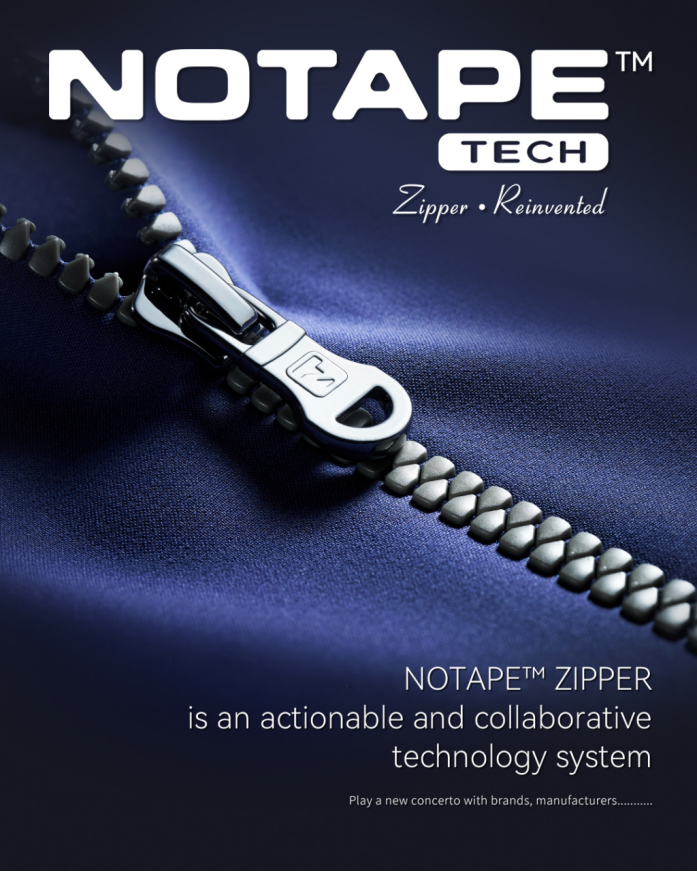
NOTAPE™ develops proprietary no-tape coil zippers and no-tape, no-seam resin zippers using specialized equipment that integrates zipper components with fabric.
Importantly, no-seam refers to eliminating conventional zipper-tape attachment stitching—not removing every seam from the garment.
3. How Does High Performance Zipper Construction Reduce Weight?
All weight reduction begins with the identification of removable components.
Traditionally, a zipper assembly consists of elements such as teeth, tape, slider, puller, stops, and attachment materials.
Eliminating textile tape allows a High Performance Zipper to eliminate a supporting component, thus reducing the elements supported by tape.
Analysis of Structural Differences
| Factor of Design | Conventional Zipper | NOTAPE™ Tapeless Approach |
| Textile Tape | Separate supporting component | Eliminated |
| Elements attachment | Elements supported by tape | Integrated with fabric |
| Attachment Stitching | Conventional tape sewing | Depends on zipper technology |
| Localized Bulk | Includes tape and attachment layers | Fewer overlapping layers |
| Color matching | Tape color requires coordination | No separate tape color |
| Manufacturing | Conventional sewing equipment | Special processes |
Note: For weighing comparisons, equivalent zipper lengths and elements must be considered. Removing tape does not necessarily lead to a given percentage weight reduction of a finished garment.
4. Three Engineering Factors Behind Lightweight Zipper Performance
A. Load Distribution and Attachment Strength
Mechanical loads in conventional zippers are distributed between the chain and the garment by means of zipper tape.
Without tape, the attachment system must transfer these forces directly into the fabric.
This makes fabric construction, element positioning, and attachment integrity particularly important.
A High Performance Zipper should therefore be evaluated for:
•Crosswise chain strength.
•Slider and stop retention.
•Element-to-fabric attachment integrity.
•Resistance to deformation under repeated loading.
ASTM D2061 provides established methods for evaluating several properties of zipper strength. Integrated constructions may require additional application-specific testing.
B. Flexibility and Fabric Drape
•A zipper introduces a comparatively rigid region into flexible fabric.
•Conventional tape and stitching can increase bending resistance around the closure.
•Lessening these layers could provide a flatter transition between the zipper and adjacent garment panels.
Flexibility will also depend on element geometry, fabric elasticity and assembly conditions. It should be assessed on final garment samples.
C. Water Resistance Without Conventional Coatings
Seamless construction and water resistance are two different engineering requirements.
Conventional water resistant zippers utilize coated or laminated tape to seal off the water penetration path and therefore help to confer water resistance.
NOTAPE™ SEAL takes another approach.
Its Structural Engineered Anti-Leak (SEAL) technology uses engineered zipper geometry and a physical barrier rather than conventional tape coatings.
Water-resistant performance must still be verified against the intended exposure conditions. A water-resistant zipper does not automatically make an entire garment waterproof.
5. High Performance Zipper Applications in Technical Apparel
| Application | Key Requirements | Design Considerations |
| Lightweight outdoor jackets | Low weight, weather resistance | Water ingress, attachment strength |
| Running apparel | Flexibility, low bulk | Fabric movement, skin comfort |
| Cycling clothing | Low-profile construction | Repeated bending, zipper operation |
| Technical sportswear | Durability, clean integration | Stretch compatibility, laundering |
| Minimalist everyday clothing | Flat appearance, reliable fastening | Fabric drape, consistency |
A High Performance Zipper should be selected based on the requirements of the garment rather than the appearance of the zipper.
6. How to Specify and Test a High Performance Zipper
The assessment of six criteria needs to be done prior to bulk production.
•Mechanical Strength: Acceptable strength of chain and sliders and attachment strength needs to be defined.
•Cycling Durability: Needs to assess repeated opening and closing including operation after laundering.
•Weight: Needs to compare complete assemblies of equivalent specifications.
•Fabric: Needs to assess elasticity, thickness, structure and fiber composition.
•Environmental Resistance: Resistance to abrasion, washing and water penetration.
•Production Feasibility: Assess equipment and consistency of installation. Sample to production repeatability.
NOTAPE™ technology is particularly suited to certain woven and knitted nylon and polyester fabrics. Evaluation of other fabrics should be assessed on a case-by-case basis.
Highly elastic or unfamiliar fabrics should be assessed on a case-by-case basis as well.
We recommend assessing the actual fabrics and zippers prior to bulk production.
Explore a Different Approach with NOTAPE™
At NOTAPE™, we believe zipper design is part of garment engineering.
Our no-tape and no-seam technologies enable apparel designers and engineers to look beyond conventional zipper designs, particularly in situations where weight and thickness of fabric integration are considerations.
If you are developing lightweight outdoor clothing, sportswear, or technical apparel, we welcome the opportunity to evaluate your fabric and application requirements.
Explore NOTAPE™ High Performance Zipper technology and see how a different closure structure could fit your next collection.
FAQs
Q1: What does NOTAPE™ mean?
NOTAPE” means eliminating the traditional fabric tapes of the zipper, allowing the zipper to integrate directly with the fabric structure.
Q2: What makes NOTAPE™ zippers uniquely different?
We come at a premium — because true innovation is rare. NOTAPE™ is not available to every brand. By integrating our no tape zipper technology, your products gain a level of exclusivity and uniqueness that sets them apart.
Q3: Does every garment using a NOTAPE™ zipper require customization?
Good question.
Not every piece requires customization, but each zipper style must undergo preliminary validation testing before production.
Q4: Can NOTAPE™ coil zippers be repaired?
No. Coil zippers cannot be repaired.
However, the damage rate for coil zippers is extremely low.
Q5: Are there requirements regarding fabric type or thickness when using NOTAPE™ zippers?
Currently, NOTAPE™ technology is more suitable for synthetic fibers such as nylon and polyester, as well as woven, knitted, low-elastic, or non-elastic fabrics.
The applicability of other materials is still under development and testing.



Contact Us
Related Posts
How Should Brands Evaluate Zipper Performance for High-End Outdoor Clothing?
November 17, 2026
Notape pitches lighter repairable zippers
November 16, 2026
130 Years Later, Cars Were Reinvented by Electrification. What About the Zipper?
October 12, 2026
Waterproof Zipper without Coating Supplier | NOTAPE™ No Coating Zipper Technology
September 26, 2026


