




Sustainable Zipper for Apparel: Preparing Apparel Trims for the EU Digital Product Passport
By hqt
10, 2026Related Posts
How Should Brands Evaluate Zipper Performance for High-End Outdoor Clothing?
November 17, 2026
Notape pitches lighter repairable zippers
November 16, 2026
130 Years Later, Cars Were Reinvented by Electrification. What About the Zipper?
October 12, 2026
Waterproof Zipper without Coating Supplier | NOTAPE™ No Coating Zipper Technology
September 26, 2026
A zipper is easy to overlook when brands discuss the EU Digital Product Passport (DPP). But that is exactly why it deserves attention.
Under the EU Ecodesign for Sustainable Products Regulation, textile apparel is a priority product group for future DPP requirements. The European Commission currently plans to adopt the textile ESPR delegated act in Q4 2027. Final textile-specific data fields are not yet fixed, but the direction is clear: product information is expected to become more structured, traceable and useful across the lifecycle.
For a Sustainable Zipper for Apparel, the practical question is no longer only, “Is this zipper eco-friendly?” It is: Can the supplier explain its materials, environmental data, durability, repairability and end-of-life information?
What Does the DPP Mean for Apparel Trims?
The DPP is primarily a product-level responsibility. Under the European Commission’s current framework, the economic operator placing textile apparel on the EU market will generally be responsible for making the required DPP available. Suppliers may also be required to provide relevant information available to them.
The data flow may therefore look like this:
Trim supplier → Garment manufacturer → Brand / economic operator → Product DPP
For zipper suppliers, “DPP readiness” should therefore mean data readiness—not claiming that every zipper already needs its own Digital Product Passport.
What Data Should a Sustainable Zipper for Apparel Supplier Prepare?
The European Commission indicates that future textile DPP information may include product identification, fibre composition where relevant, use and maintenance, repair, disassembly, recycling, origin and economic-operator information. Exact requirements will depend on the final delegated act.
Brands can therefore begin organizing component-level information now:
| Data Category | Zipper-Level Question | Why It Matters |
| Identification | What type and specification is supplied? | Traceability |
| Materials | What are the teeth, slider, tape or other layers made from? | Material transparency |
| Origin | Where is the component produced? | Supply-chain mapping |
| Environmental data | Is carbon or resource data available? | Claim verification |
| Durability | Are cycling, washing or abrasion results documented? | Product lifetime |
| Repair | Can damage be repaired without replacing the whole closure? | Longer use |
| Disassembly | How is the zipper connected to the garment? | End-of-life decisions |
| Verification | Are test reports or third-party assessments available? | Evidence quality |
This should be treated as a DPP-readiness framework, not a list of finalized mandatory DPP fields.
“Sustainable“ Is Not a Data Point
A recycled-material label can be useful, but it does not prove the complete environmental performance of a Sustainable Zipper for Apparel.
At least four questions should be answered to enable an adequate environmental comparison.
•Functional Unit: Is the comparison made zipper-by-zipper? meter-by-meter? Some other pre-defined unit?
•Baseline: Which conventional zipper is being compared?
•System Boundary: What part of the materials and manufacturing processes is being included?
•Verification: Was the result arrived at by an internal calculation or by a third party assessment?
Answers to these questions would be needed in order for a potential customer to sufficiently understand the particulars of a comparison.
Procurers of a Sustainable Zipper for Apparel should request the methodology, not simply the results.
Conventional Zipper vs Tape-Free Structure: What Changes?
A conventional zipper normally uses textile tape to carry the zipper elements before the tape is attached to garment fabric.
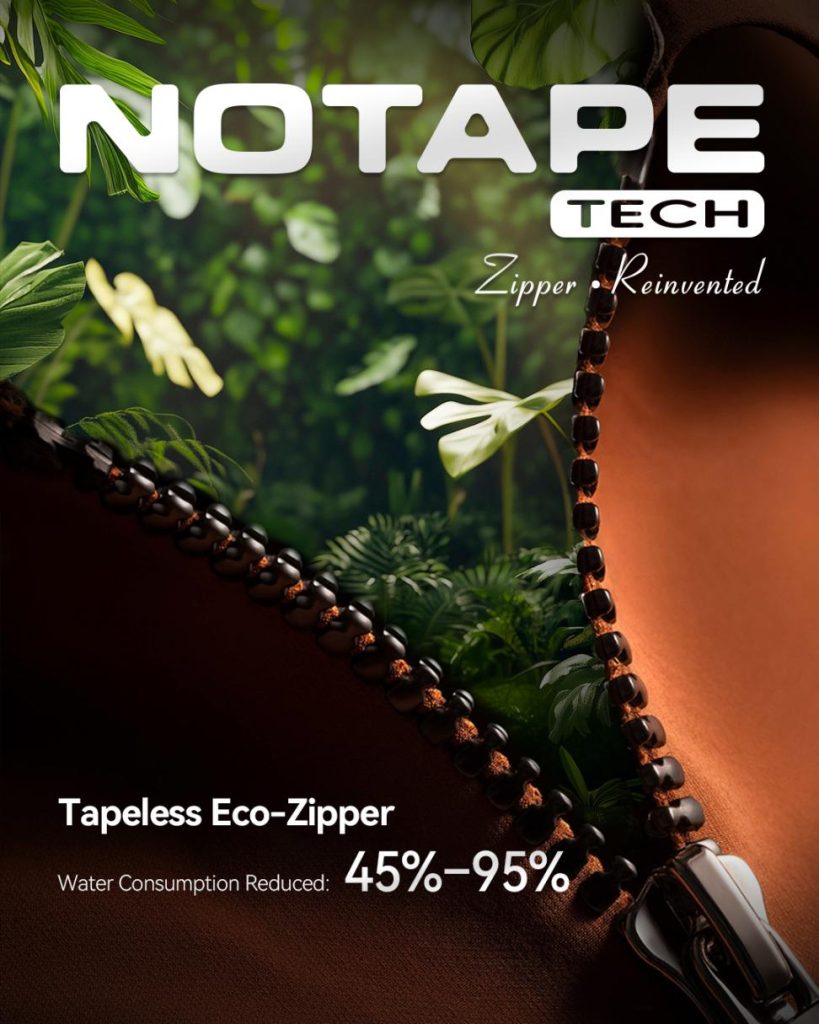
NOTAPE™ takes a different structural approach. Its No Tape design removes the separate textile tape layer and integrates the zipper structure more directly with compatible garment fabric. NOTAPE™ describes the basic structural change as moving from teeth + tape + garment fabric toward zipper elements + garment fabric.
| Dimension | Conventional Structure | Tape-Free Structure |
| Main layers | Teeth + tape + garment fabric | Teeth + garment fabric |
| Separate tape data | Required | Reduced or eliminated |
| Tape color matching | Normally relevant | Removed with the tape layer |
| Material tracking | More structural layers | Structurally simplified |
| DPP readiness | Depends on documented data | Also depends on documented data |
The key distinction is important: fewer layers do not automatically make a zipper “DPP compliant.”
Structural simplification may reduce the number of materials and manufacturing processes that need to be understood and documented, but traceability, performance evidence and environmental verification still matter.
NOTAPE™: A Case of Measurable Structural Reduction
NOTAPE™ provides another way to think about developing a Sustainable Zipper for Apparel.
Instead of focusing only on replacing virgin material with recycled material, its No Tape concept starts by asking whether an existing structural layer is necessary at all. Removing conventional zipper tape can reduce associated material input and tape-related processing requirements.
This distinction matters:
•Material substitution: Replace one material with another.
•Structural reduction: Remove a material or process that the redesigned product no longer requires.
At NOTAPE™, we support our sustainability approach with comparative environmental data rather than broad environmental claims. Based on TÜV-certified assessments, the evaluated NOTAPE™ zipper configurations show approximately 19.4%–26.6% lower carbon emissions compared with corresponding conventional zipper structures.
We also recognize that these figures should not be applied as a universal reduction rate to every NOTAPE™ zipper. Actual results vary depending on the zipper type, specification, comparison baseline and assessment conditions. For this reason, we believe carbon-reduction data should always be considered together with its defined comparison method and evaluation scope.
For sourcing teams, those qualifications are as important as the percentage itself.
A DPP-Readiness Checklist for Apparel Buyers
Before approving a Sustainable Zipper for Apparel, sourcing teams should ask:
•Can each relevant zipper material be documented?
•Is manufacturing origin identifiable?
•Are environmental claims supported by measurable data?
•Is the comparison baseline clearly defined?
•Is third-party verification available?
•Are durability and maintenance data documented?
•Can repair, disassembly or recycling information be supplied?
•Can this information be structured for integration into a future garment-level DPP?
These questions shift sustainability from a marketing label into a supplier-evaluation and procurement process.
Prepare the Data Before the Passport Is Mandatory
The difficult part of a future DPP may not be creating the QR code. It may be reconstructing missing information across fabrics, trims and components after the requirements have already been finalized.
Brands can start earlier by identifying critical trim data, standardizing supplier documentation, verifying environmental claims and connecting component information with garment-level records.
Teams evaluating a Sustainable Zipper for Apparel have a good example of how simplifying a design can be substantiated with measurable environmental information in NOTAPE™. Apparel brands, designers, and sourcing teams who are interested in NOTAPE’s™ approach can check NOTAPE’s™ No Tape technology and sustainability information through NOTAPE™‘s website.
FAQs
Q1: Can we view videos or technical materials showing the zipper manufacturing process?
Depending on the stage of cooperation and mutual evaluation between parties, and as sample testing and customized development progress, certain process-related technical materials may be gradually shared with clients.
Q2: How are the zipper top stop and bottom stop handled?
The zipper structure is formed using patented equipment and specialized process treatments.
Q3: Is NOTAPE™ a copy or imitation?
No. NOTAPE™ is the world’s first to develop tape-free zipper solutions and holds exclusive patented technologies for both no tape coil zippers and no tape, no seam resin zippers.
Q4: Are there detailed specifications for NOTAPE™ zipper styles, colors, sizes, and customization options?
“We provide dedicated color cards and profiles.
If you have further questions, our team can assist you directly.”
Q5: Does every garment using a NOTAPE™ zipper require customization?
Good question.
Not every piece requires customization, but each zipper style must undergo preliminary validation testing before production.



Contact Us
In This Article
Related Posts
How Should Brands Evaluate Zipper Performance for High-End Outdoor Clothing?
November 17, 2026
Notape pitches lighter repairable zippers
November 16, 2026
130 Years Later, Cars Were Reinvented by Electrification. What About the Zipper?
October 12, 2026
Waterproof Zipper without Coating Supplier | NOTAPE™ No Coating Zipper Technology
September 26, 2026


