




Optimizing Carbon Footprint at the Source: No Tape Eco Zipper for a Greener Apparel Industry
By hqt
08, 2026Related Posts
130 Years Later, Cars Were Reinvented by Electrification. What About the Zipper?
October 12, 2026
Waterproof Zipper without Coating Supplier | NOTAPE™ No Coating Zipper Technology
September 26, 2026

From No Tape to Water Resistance Without Coating: NOTAPE™ Rethinks the Zipper Through Its “Three-No” Design
September 14, 2026

NOTAPE™Returns to Intertextile Shanghai Apparel Fabrics with Groundbreaking NO TAPE, NO SEAM, NO COATING Zipper Innovation
August 06, 2026
In 2026, the apparel industry will experience a shift from broad sustainability pledges to the inclusion of empirical data on the impact of products.
Apparel brands are being scrutinized over the sustainability of a product’s components and the implications of those components on energy use, water use, chemical inputs, carbon emissions, waste, and the management of a product’s end-of-life.
This change makes small components more relevant to ESG strategy. A zipper may account for only a limited share of a garment’s total environmental footprint, but it is used across millions of products and involves materials, dyeing, finishing, transportation, and assembly.
For NOTAPE™, the environmental question begins at the structural level: can the conventional zipper tape be removed at the source?
Why 2026 Matters for Sustainable Apparel
Several European policy developments are making environmental data more important for apparel brands and their suppliers.
| 2026 Policy Development | Relevance to Apparel Supply Chains |
| Ban on destroying unsold apparel | From July 19, 2026, large companies covered by the EU Ecodesign for Sustainable Products Regulation are prohibited from destroying unsold apparel, clothing accessories, and footwear, subject to defined exemptions. |
| Stronger rules against greenwashing | From September 27, 2026, the EU’s Empowering Consumers for the Green Transition Directive will strengthen consumer protection against misleading environmental claims. |
| Preparation for textile EPR | The revised EU Waste Framework Directive requires Member States to develop Extended |
Producer Responsibility schemes for textiles and footwear, increasing attention to product volumes, waste costs, collection, reuse, and recycling.
These policies do not make a particular zipper automatically compliant. However, they increase the value of verified supplier data, lower-impact component design, clearer material documentation, and environmental claims supported by defined assessment conditions.
The magnitude of the issue is considerable. For example, EU customers purchased an average of almost 19 kg of clothing, footwear, and household textiles per person in 2022. The supply chain providing this demanded an estimated 159 million tonnes of CO₂ equivalent. About 85% of the water used for textiles consumed in Europe was used outside of Europe, predominantly in production regions in Asia.
An Eco Zipper Should Be Supported by Data
Terms such as Eco Zipper, Green Zipper, and Sustainable Zipper should not depend only on visual identity or general environmental language.
For sourcing teams, a more useful question is:
Which materials and processes have been reduced, and by how much?
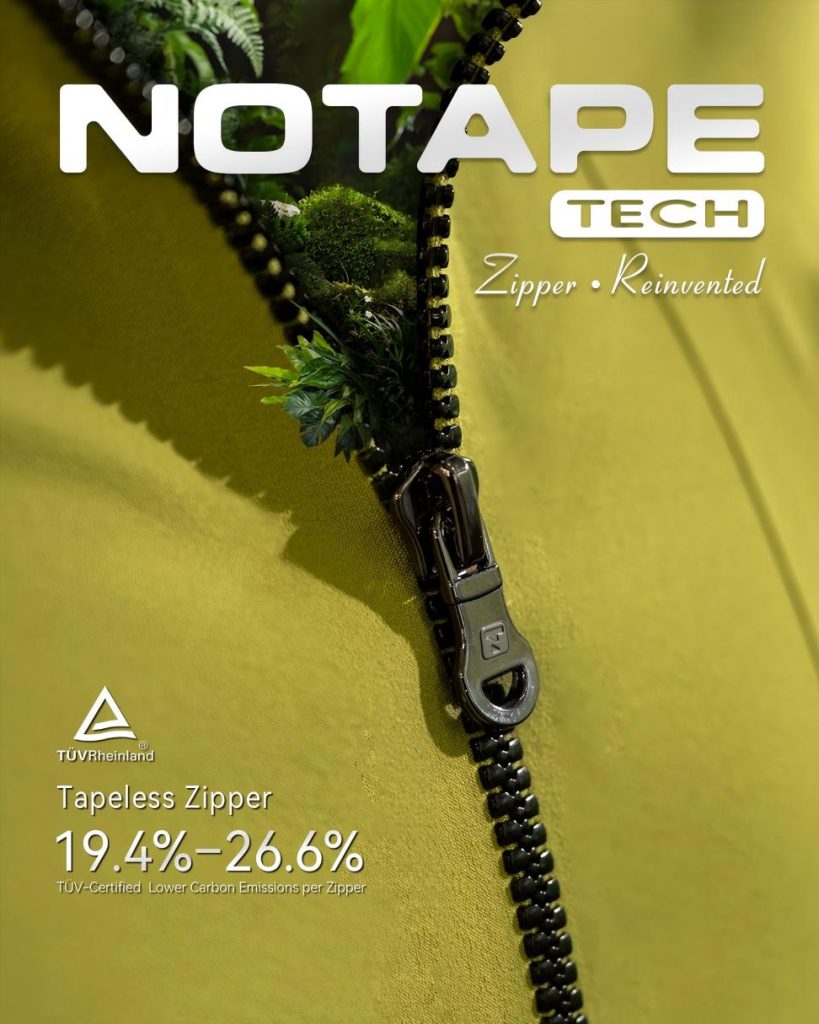
According to TÜV-certified comparative data published by NOTAPE™, the NOTAPE™ No Tape Eco Zipper provides the following reductions compared with corresponding conventional zipper structures:
| Environmental Indicator | Reported Comparative Reduction |
| Zipper weight | 25%–45% |
| Energy consumption | 32%–42% |
| Chemical use | 45%–62% |
| Water consumption | 45%–95% |
| Carbon footprint | Approximately 19.4%–26.6% |
The ranges vary because Coil Zipper and Resin Zipper structures, specifications, sizes, lengths, materials, and production routes are not identical. Environmental results should therefore be communicated together with the applicable product type, comparison basis, and assessment boundary.
This type of qualification is particularly important as environmental marketing rules become stricter. Rather than simply describing a product as “green,” brands need evidence that explains what was assessed and what changed.
Source Reduction: Removing Processes Before Optimizing Them
A conventional zipper tape normally passes through several material and processing stages before the zipper is installed on a garment. Depending on the specification, these stages may include yarn production, weaving, dyeing, heat setting, finishing, color matching, transportation, and sewing.
The NOTAPE™ No Tape structure removes the separate textile tape from the zipper system. This means that some tape-related materials and processing requirements are avoided rather than substituted with another material.
The environmental rationale is straightforward:
•Reducing zipper weight per garment reduces material requirements.
•Zippers require processing, so removing them reduces energy processing demands.
•For dyeing and finishing, inputs may be reduced and, consequently, reduced chemical consumption.
•Not dyeing and treating tape reduces water consumption.
•Less material and processing demands yield a smaller carbon footprint.
This is why the reported reductions do not come from a single environmental measure. They reflect several avoided inputs across the zipper production process.
Turning Component-Level Data into Actionable ESG Decisions
For apparel brands, the practical value of a Sustainable Zipper lies in how its data can be incorporated into sourcing and ESG management.
| ESG Requirement | Potential Use of NOTAPE™ Data |
| Scope 3 supplier engagement | Compare component-level carbon footprints under consistent assessment boundaries |
| Water-risk management | Identify accessories that avoid water-intensive tape processing |
| Chemical management | Record reductions in dyes, auxiliaries, and related processing chemicals |
| Material efficiency | Measure weight reduction per zipper and across total order quantities |
| Environmental claims | Support specific percentage-based statements instead of undefined green claims |
| Product development | Include lower-impact components during the design and material-selection stage |
For example, a 30% weight reduction in one zipper may appear modest when viewed separately. Across 100,000 garments, however, the reduction becomes a measurable quantity of avoided component material.
The same principle applies to water, chemicals, energy, and carbon: procurement volume determines the total effect.
From a Green Product to a Greener Supply Chain
Europe is estimated to destroy approximately 4%–9% of textile products before they are ever used, representing between 264,000 and 594,000 tonnes annually. The European Commission estimates that this practice creates approximately 5.6 million tonnes of CO₂ emissions.
Improved forecasting; durability of products; enhanced reuse and recycling; better inventory control; and reduced environmental impact. Additionally, product design with better control of input can have a positive effect.
NOTAPE™ No Tape Eco Zippers tackle one finite section of this larger problem. They will not substitute the need for a comprehensive ESG strategy. However, these Eco Zippers provide brands an opportunity to reduce weight, use of energy and chemistry, and water and carbon impacts through simplification of structure.
With the emergence of a more data-oriented approach to apparel sustainability, the meaning of a Green Zipper continues to evolve and will include greater specificity to environmental value that can be identified and measured, as well as be directly communicated under a defined set of circumstances.
For brands considering their sourcing strategies for 2026, the zipper is no longer too small of a detail to be considered. Product design and ESG performance can be integrated through this detail.
Contact NOTAPE™ to explore No Tape Eco Zipper solutions for your lower-carbon apparel supply chain.
FAQs
Q1: Are NOTAPE™ zippers water-resistant in rainy or heavy rain conditions?
Yes, NOTAPE provides a range of water protection solutions tailored to different garment applications and performance requirements. Depending on the end-use scenario, customers can choose from water-repellent solutions to higher-level water-resistant solutions.
Q2: Is NOTAPE™ a copy or imitation?
No. NOTAPE™ is the world’s first to develop no tape zipper solutions and holds exclusive patented technologies for both no tape coil zippers and no tape, no seam resin zippers.
Q3: Does NOTAPE™ SEAL provide the same level of water protection as conventional waterproof zippers? How waterproof is it?
NOTAPE™ is the world’s first no tape, no seam and water-resistant zipper without coating, so there is currently no dedicated testing standard for this type of zipper. As a result, its performance is assessed using the same industry test methods applied to conventional water-resistant zippers.
Independent testing by ITS and SGS confirms that the NOTAPE™ SEAL series meets the water-resistant performance requirements of internationally recognized European, American, and Chinese industry standards.
Q4: What kind of brand is NOTAPE™?
NOTAPE™ was founded in Hong Kong and is a technology-driven brand serving the global market, with a focus on innovative zipper technologies.
Q5: How are the zipper top stop and bottom stop handled?
The zipper structure is formed using patented equipment and specialized process treatments.



Contact Us
In This Article
Related Posts
130 Years Later, Cars Were Reinvented by Electrification. What About the Zipper?
October 12, 2026
Waterproof Zipper without Coating Supplier | NOTAPE™ No Coating Zipper Technology
September 26, 2026
From No Tape to Water Resistance Without Coating: NOTAPE™ Rethinks the Zipper Through Its “Three-No” Design
September 14, 2026
NOTAPE™Returns to Intertextile Shanghai Apparel Fabrics with Groundbreaking NO TAPE, NO SEAM, NO COATING Zipper Innovation
August 06, 2026


