




NOTAPE™’s Green Formula: 10,000 No Tape Zippers ≈ 90 Fir Trees Planted
By hqt
07, 2026Related Posts
130 Years Later, Cars Were Reinvented by Electrification. What About the Zipper?
October 12, 2026
Waterproof Zipper without Coating Supplier | NOTAPE™ No Coating Zipper Technology
September 26, 2026
From No Tape to Water Resistance Without Coating: NOTAPE™ Rethinks the Zipper Through Its “Three-No” Design
September 14, 2026

NOTAPE™Returns to Intertextile Shanghai Apparel Fabrics with Groundbreaking NO TAPE, NO SEAM, NO COATING Zipper Innovation
August 06, 2026
In sustainable apparel, every detail matters.
Fabric matters. Dyeing matters. Packaging matters. Yet one essential component is often overlooked—the zipper.
For apparel brands pursuing ESG goals, carbon reduction, responsible material use, and more sustainable product development, the zipper is no longer just a functional trim. It has become part of the product’s sustainability story.
This is where NOTAPE™ offers a different approach.
As an Eco Zipper, Green Zipper, and Sustainable Zipper solution, NOTAPE™ tape-free Zipper Technology helps apparel brands reduce material consumption while delivering measurable environmental benefits.
The formula is simple.
Using 10,000 NOTAPE™ zippers can reduce approximately 1,617 kg of CO₂ emissions—equivalent to the carbon sequestration of planting approximately 90 fir trees.
For brands developing ESG-driven product collections, even replacing a conventional zipper can become a meaningful step toward more responsible product development.
01. Why ESG Begins with Small Apparel Details
ESG is not defined only by large manufacturing systems or major material innovations.
It is also shaped by the countless design decisions embedded within every garment.
A jacket, sportswear piece, cycling garment, or sun-protective layer contains numerous trims. Each component consumes materials, energy, water, chemicals, packaging resources, and manufacturing processes. Across thousands—or even millions—of garments, these seemingly small components create a measurable environmental impact.
Traditional zipper construction relies on textile tape, multiple material layers, dyeing processes, and additional manufacturing steps. Although each zipper appears insignificant, its cumulative environmental footprint is considerable.
NOTAPE™ begins by eliminating traditional zipper tape.
Its No Tape construction reduces unnecessary material from the zipper structure itself, helping apparel brands develop products with a cleaner construction and a lower environmental footprint.
02. The Green Value of No Tape Zipper Technology
The environmental philosophy behind NOTAPE™ is straightforward.
A simpler zipper structure can deliver a more sustainable zipper solution.
By eliminating traditional zipper tape and integrating precision zipper teeth directly with the garment fabric, NOTAPE™ reduces unnecessary material layers and streamlines the overall zipper construction.
For apparel brands, this supports ESG objectives in several important ways.
| Focus | How NOTAPE™ Supports It |
| Environmental | Reduces carbon emissions, material waste, H2O, and energy use, and cuts down on chemicals |
| Responsibility | Constructs garments with fewer unnecessary layers |
| Supply Chain | Eliminates tape-related material and color-matching |
| Sustainability | Provides brands with data to support and prove their commitment to ESG |
| Consumer Value | Visible product design that promotes corporate sustainability |
This makes NOTAPE™ more than simply a zipper.
It becomes part of an apparel brand’s long-term sustainability strategy.
窗体顶端
03. TÜV-Certified Carbon Reduction for More Credible Sustainability Claims
Today, sustainability claims require credible evidence.
General terms such as eco-friendly, green, or low carbon are no longer sufficient unless they are supported by measurable data.
NOTAPE™ enables apparel brands to communicate their sustainability efforts with greater confidence.
According to TÜV-certified data, NOTAPE™ tape-free Zipper Technology achieves 19.4%–26.6% lower carbon emissions compared with conventional zipper structures.
This provides sourcing teams, product developers, and sustainability teams with credible, measurable data to support ESG reporting and product communication.
Instead of simply stating that a garment uses an eco zipper or a greener zipper, brands can demonstrate that the zipper incorporates No Tape Zipper Technology supported by independent TÜV-certified carbon reduction data.
04. 10,000 NOTAPE™ Zippers ≈ 90 Fir Trees Planted
Environmental benefits become easier to understand when translated into practical comparisons.
Using 10,000 NOTAPE™ zippers can reduce approximately 1,617 kg of CO₂ emissions.
This is equivalent to the carbon sequestration provided by planting approximately 90 fir trees.
This comparison gives apparel brands an easy and meaningful way to communicate sustainability in product launches, ESG reports, customer presentations, and buyer meetings.
| Production Scale | Estimated Carbon Reduction | Environmental Comparison |
| 10,000 NOTAPE™ tape-free zippers | Approx. 1,617 kg CO₂ | Similar to planting about 90 fir trees |
This comparison is not intended to replace broader sustainability initiatives.
Instead, it illustrates how thoughtful component selection can contribute to an apparel brand’s overall ESG strategy.
05. Beyond Carbon: Less Waste, Less Water, Less Energy
Carbon emissions are only one part of sustainability.
Material efficiency, water consumption, energy use, chemical usage, and production waste are equally important when evaluating a truly sustainable zipper solution.
NOTAPE™ delivers measurable environmental improvements across multiple indicators.
| Environmental Indicator | NOTAPE™ Sustainability Value |
| Waste reduction | Up to 95% less waste |
| Carbon footprint | 19.4%–26.6% lower than traditional zipper structures |
| Carbon saving | Approx. 1,617 kg CO₂ saved per 10,000 zippers |
| Water consumption reduction | Coil zipper structures: up to 45%; plastic zipper structures: up to 95% |
| Energy consumption reduction | Coil zipper structures: up to 42%; plastic zipper structures: up to 32% |
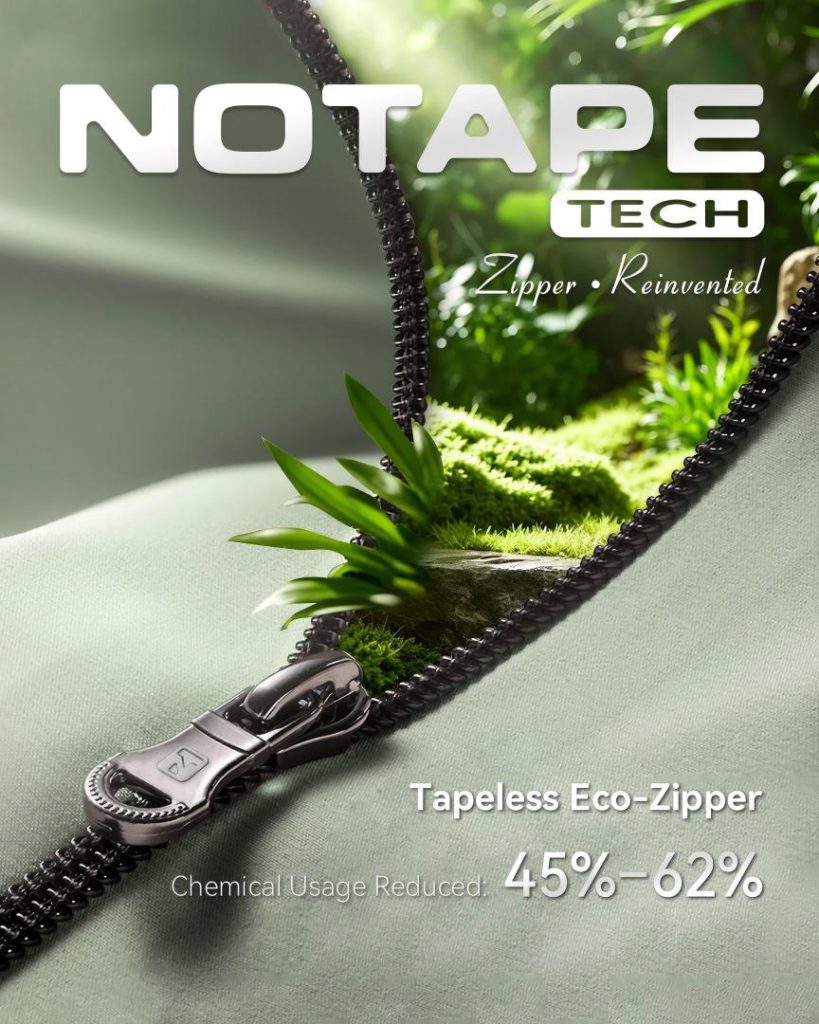
| Chemical usage reduction | Coil zipper structures: up to 45%; plastic zipper structures: up to 62% |
These measurable improvements position NOTAPE™ as an Eco Zipper, Green Zipper, and Sustainable Zipper solution for apparel brands seeking more responsible trim innovations.
For brands developing outdoor apparel, sportswear, casualwear, cycling apparel, skin jackets, sun-protective clothing, hardshell jackets, and ski apparel, these environmental benefits support more sustainable product development without requiring changes to the overall garment design.
06. Why Eco Zippers Matter for Apparel Brands
Sustainability is becoming more specific. Buyers and consumers are paying closer attention to what products are made of, how they are made, and whether sustainability claims are supported by real data.
This creates a new opportunity for Eco Zippers.
A zipper may be small, but it is visible. It is touched every day. It sits on the garment surface. It can become a practical example of how a brand improves sustainability through better details.
NOTAPE™ green zippers help brands tell a more complete ESG story:
The product uses less unnecessary material.
The zipper removes traditional fabric tape.
The carbon footprint is lower than traditional zipper structures.
The environmental data is TÜV-certified.
The garment supports a cleaner and more responsible design direction.
This kind of message is easier for buyers, designers, and end users to understand.
07. Sustainable Zippers for the Next Stage of Apparel Design
For many apparel brands, the next stage of sustainability will come from material choices, process improvements, supplier transparency, and product-level data.
NOTAPE™ fits into this direction by providing a sustainable zipper solution that can be measured, explained, and applied across suitable apparel categories.
It helps brands reduce the most recognizable part of their Environmental Impact and simplifies their ESG Communications.
In a market where green claims are becoming more closely examined, this matters.
A sustainable zipper should not only look different. It should help the brand answer practical questions:
How much carbon can be reduced?
How much material can be avoided?
Can the data support ESG communication?
Can the improvement be explained clearly to buyers and consumers?
NOTAPE™ gives brands a practical starting point.
08. A Greener Zipper Starts with a Simpler Formula
The NOTAPE™ green formula is not complicated.
Remove traditional zipper tape.
Reduce unnecessary material.
Lower the carbon footprint.
Using TÜV-certified data will level up your ESG communications.
You will gain access to your eco zip, green zip, and your sustainable zip innovations.
Using 10,000 NOTAPE™ tape-free zippers takes about 1,617 kg of carbon out of the environment. That’s the same as the positive impact of planting about 90 fir trees.
For apparel brands, it’s more than just another technical upgrade. This is a small, yet impactful, step to a more responsible product design.
For visibility, measurement, and communication of sustainability, NOTAPE™ has developed a new zipper solution to support the ESG era.
FAQs
Q1: Are NOTAPE™ zippers water-resistant in rainy or heavy rain conditions?
A1: NOTAPE provides a range of water protection solutions tailored to different garment applications and performance requirements. Depending on the end-use scenario, customers can choose from water-repellent solutions to higher-level water-resistant solutions.
Q2: What does NOTAPE mean?
A2: “NOTAPE” means eliminating the traditional fabric tapes of the zipper, allowing the zipper to integrate directly with the fabric structure.
Q3: I can see stitching beneath NOTAPE™ zipper. How can it be described as tape-free and seamless?
A3: The stitching visible belongs to the fabric construction itself and is required by the garment-making process. The zipper structure does not rely on traditional zipper tape or sewing.
Q4: Are there any specific requirements for the fabric?
A4: Yes. We have certain requirements regarding the fabric material and thickness. Please refer to the relevant guidelines for detailed specifications. For any uncertain applications, we recommend sending the fabric samples to us for testing.



Contact Us
In This Article
Related Posts
130 Years Later, Cars Were Reinvented by Electrification. What About the Zipper?
October 12, 2026
Waterproof Zipper without Coating Supplier | NOTAPE™ No Coating Zipper Technology
September 26, 2026
From No Tape to Water Resistance Without Coating: NOTAPE™ Rethinks the Zipper Through Its “Three-No” Design
September 14, 2026
NOTAPE™Returns to Intertextile Shanghai Apparel Fabrics with Groundbreaking NO TAPE, NO SEAM, NO COATING Zipper Innovation
August 06, 2026


