




Best Zipper for Modern Apparel Design: Minimal Structure, Maximum Performance
By hqt
09, 2026Related Posts
From No Tape to Water Resistance Without Coating: NOTAPE™ Rethinks the Zipper Through Its “Three-No” Design
September 14, 2026

NOTAPE™Returns to Intertextile Shanghai Apparel Fabrics with Groundbreaking NO TAPE, NO SEAM, NO COATING Zipper Innovation
August 06, 2026
Eco Zippers 2.0: How NOTAPE™ Tape-less Seamless Zipper Technology Redefines Sustainable Closures
June 15, 2026

NOTAPE™ to Debut Tape-Free, Stitch-Free Zipper Technology at European Outdoor Week 2026
May 12, 2026
For more than a century, the zipper has followed a familiar construction: teeth are fixed to textile tape, and the tape is sewn onto the garment.
At NOTAPE™, we began with a simple question:
What would change if the tape were removed?
After more than a decade of testing, adjustment and process development, that question became a practical No Tape structure. Instead of treating the zipper as an accessory added to a garment, NOTAPE™ integrates the closure structure directly with the fabric.
This does not mean that one product is automatically the Best Zipper for every garment. The more useful question is whether the zipper structure matches the fabric, design, performance target and production process.
The Best Zipper Is Part of the Garment System
Modern apparel design increasingly prioritizes low weight, clean lines, material efficiency and reliable performance. Zipper selection therefore needs to begin earlier in product development.
Designers and sourcing teams should evaluate:
•Fabric composition, thickness and stretch behavior
•Garment panel structure and reinforcement requirements
•Expected opening and closing frequency
•Weight and flexibility targets
•Water-resistant performance requirements
•Washing, abrasion and long-term use conditions
•Factory equipment, processing parameters and quality-control procedures
The Best Zipper should work with these variables rather than forcing the garment to accommodate an unnecessary structural layer.
Inside the NOTAPE™ No Tape Structure
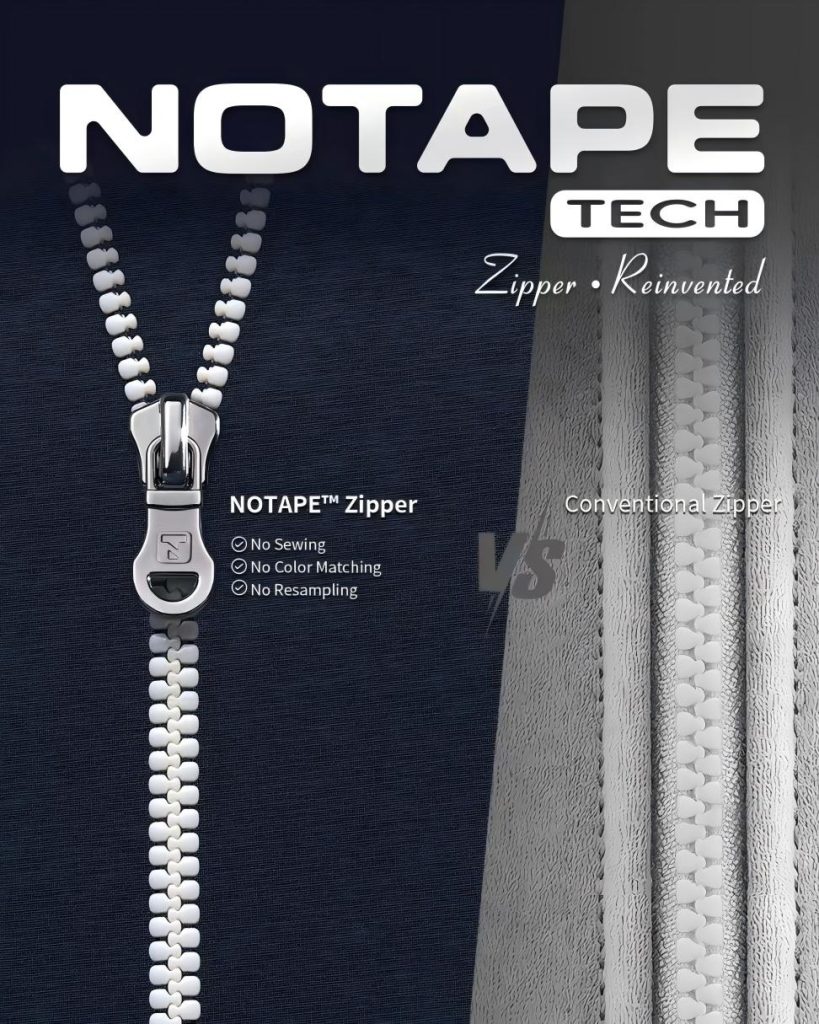
A conventional zipper uses textile tape as the carrier for the teeth. NOTAPE™ removes this separate carrier and keeps the essential components: teeth, slider, puller, pin and box, and stoppers.
The zipper structure is attached directly with the garment fabric. This changes both the appearance and construction logic of the closure.
| Evaluation dimension | Conventional zipper | NOTAPE™ solution |
| Structural interface | Teeth, tape and garment panel | Zipper structure integrated with fabric |
| Tape management | Separate tape inventory required | No zipper tape inventory |
| Color coordination | Tape shade must be matched | No tape color-matching cycle |
| Attachment process | Tape positioning and sewing | Direct fabric integration |
| Visual result | Visible attachment layers | Cleaner closure line |
| Material use | Includes separate textile tape | Fewer structural materials |
NOTAPE™ provides two distinct technical routes:
No Tape Coil Zipper: removes the conventional zipper tape while retaining an appropriate sewing process.
No Tape, No Seam Resin Zipper: removes both the tape and the separate tape-sewing structure.
Keeping this distinction clear helps product developers select the Best Zipper according to the actual garment construction.
Lightweight Performance Supported by Data
A few grams can matter in cycling apparel, skin jackets, sun-protective clothing and lightweight outerwear. The effect becomes more significant when weight is evaluated across several garment components or a large production volume.
For a #5 zipper measuring 65 cm:
| Zipper configuration | Conventional zipper | NOTAPE™ No Tape Zipper |
| Resin Zipper | 12–15 g | 6.66 g |
| Coil Zipper | 11–14 g | 6.5 g |
Final weight varies with length, component specification and garment configuration. However, the comparison shows that structural simplification can contribute to meaningful component-level weight reduction.
For designers seeking the Best Zipper for lightweight apparel, the assessment should also consider:
•Closure stability after repeated operation
•Fabric distortion around the zipper
•Slider movement under garment tension
•Attachment strength
•Dimensional stability after washing
•Comfort when the garment bends or moves
Weight reduction is useful only when the completed garment continues to meet its functional requirements.
NOTAPE™ SEAL: Water Resistance Without Coating
Water-resistant zipper design has traditionally relied on treatments applied to the zipper tape. Tape absorbency, sewing needle holes and coating wear can affect long-term performance.
NOTAPE™ SEAL Water-resistant Zipper: No Tape, No Seam, No Coating uses Structural Engineered Anti-Leak Technology to take a different route.
The structure removes absorbent tape and tape-sewing needle holes. Through precise teeth attachment directly with the fabric, it forms a physical barrier that provides water-resistant performance without a coating.
This approach offers several practical characteristics:
•No absorbent zipper tape
•No tape-sewing needle holes
•No coating that may wear through washing or abrasion
•A thinner, cleaner closure profile
•More than 30% weight reduction, depending on configuration
•Self-supporting teeth designed to balance thinness and strength
For hardshell jackets, ski apparel and other weather-facing garments, the Best Zipper cannot be assessed separately from the finished product. Water resistance should be verified after assembly because fabric selection, panel preparation, attachment parameters and garment design all affect the final result.
Environmental Performance Beyond General Claims
Material reduction can also affect water, energy, chemical use and carbon emissions. TÜV-certified data indicates that NOTAPE™ zipper solutions can achieve 19.4%–26.6% lower carbon emissions within the assessed product boundaries.
| Environmental indicator | Coil Zipper reduction | Resin Zipper reduction |
| Water consumption | 45% | 95% |
| Energy consumption | 42% | 32% |
| Chemical usage | 45% | 62% |
| Weight | 45% | 25% |
NOTAPE™ also reports up to 95% less waste and 1,617 kg of CO₂ savings per 10,000 units under the specified #5 Resin Zipper conversion conditions.*
These figures allow brands to evaluate a Best Zipper candidate through measurable indicators rather than relying only on broad terms such as “green” or “sustainable.”
What the No Tape Structure Changes in Production
The benefits of structural simplification extend beyond the design studio. On the production line, removing zipper tape can reduce several material-management and assembly tasks.
Manufacturers may gain:
•Fewer zipper materials to purchase and track
•No separate tape color-matching cycle
•Less tape-related storage and handling
•Fewer attachment steps for compatible configurations
•Cleaner line-balancing opportunities
•More consistent closure positioning through defined parameters
However, successful adoption still requires technical preparation. Fabric combinations should be tested, operating parameters should be documented, and pilot production should be evaluated before scaling.
At NOTAPE™, we consider these steps part of selecting the Best Zipper, because component performance and production repeatability must be developed together.
A More Practical Definition of the Best Zipper
The Best Zipper for modern apparel design is not necessarily the most familiar or the most complex option. It is the zipper that delivers the required balance of appearance, weight, durability, water resistance, manufacturing efficiency and environmental performance.
By removing conventional tape, NOTAPE™ gives apparel designers another structural route to explore:
•No Tape for reduced material layers
•No Seam in compatible Resin Zipper configurations
•No Coating in the NOTAPE™ SEAL series
•Direct fabric integration for a cleaner design language
•Quantifiable resource savings for more credible ESG communication
A zipper occupies only a narrow line on a garment. Yet when its structure changes, that line can influence product design, factory operations and material use at the same time.
*Based on #5 Resin Zipper conversion standards, with each fir tree assumed to absorb 18 kg of CO₂ annually.
FAQs
Q1: What types of garments can NOTAPE™ zippers be used for? Can they be used for bags, hats, or cases?
NOTAPE™ currently focuses on the high-end apparel segment, primarily covering down jackets, windbreakers, lightweight jackets, and business-formal garments.
If future application directions are updated, we will inform our partners in a timely manner and share relevant technical and application information accordingly.
Q2: Does every garment using a NOTAPE™ zipper require customization?
Good question. Not every piece requires customization, but each zipper style must undergo preliminary validation testing before production.
Q3: If a NOTAPE™ zipper is damaged, can it be replaced or repaired? How is it repaired? Will it affect the garment?
Individual zipper teeth on plastic zippers can be repaired without affecting the garment.
Q4: How is the pricing of NOTAPE™ zippers?
NOTAPE™ is positioned as a premium solution. Higher cost reflects the innovation and technology involved.
Q5: How does the physical performance of NOTAPE™ zippers compare? Do they meet industry usage standards? Do they meet the standards used for traditional zippers?
NOTAPE™ is a global first and currently has no independent standard. At present, testing is conducted with reference to the execution standards of traditional zippers. All physical performance test data meets or exceeds existing industry standards (EU, US, and international standards).



Contact Us
In This Article
Related Posts
From No Tape to Water Resistance Without Coating: NOTAPE™ Rethinks the Zipper Through Its “Three-No” Design
September 14, 2026
NOTAPE™Returns to Intertextile Shanghai Apparel Fabrics with Groundbreaking NO TAPE, NO SEAM, NO COATING Zipper Innovation
August 06, 2026
Eco Zippers 2.0: How NOTAPE™ Tape-less Seamless Zipper Technology Redefines Sustainable Closures
June 15, 2026
NOTAPE™ to Debut Tape-Free, Stitch-Free Zipper Technology at European Outdoor Week 2026
May 12, 2026


