




Lightweight Zipper Technology: Removing a Zipper Tape Changes More Than a Weight Reduction
By hqt
08, 2026Related Posts
130 Years Later, Cars Were Reinvented by Electrification. What About the Zipper?
October 12, 2026
Waterproof Zipper without Coating Supplier | NOTAPE™ No Coating Zipper Technology
September 26, 2026
From No Tape to Water Resistance Without Coating: NOTAPE™ Rethinks the Zipper Through Its “Three-No” Design
September 14, 2026

NOTAPE™Returns to Intertextile Shanghai Apparel Fabrics with Groundbreaking NO TAPE, NO SEAM, NO COATING Zipper Innovation
August 06, 2026
In apparel design, lightweight construction is rarely achieved through one dramatic change. It usually comes from reconsidering every layer, component, seam and accessory.
The zipper is one of those components.
For more than a century, the conventional zipper structure has generally combined chain elements, textile tape and garment fabric. Although the tape may appear to be a minor part, it adds weight, thickness and another visible layer to the finished garment.
The World’s First No Tape Coil Zipper developed by NOTAPE™ removes this separate textile tape. This structural change affects not only zipper weight, but also garment appearance, material coordination and the way designers approach lightweight construction.
A Small Component with a Measurable Weight Difference
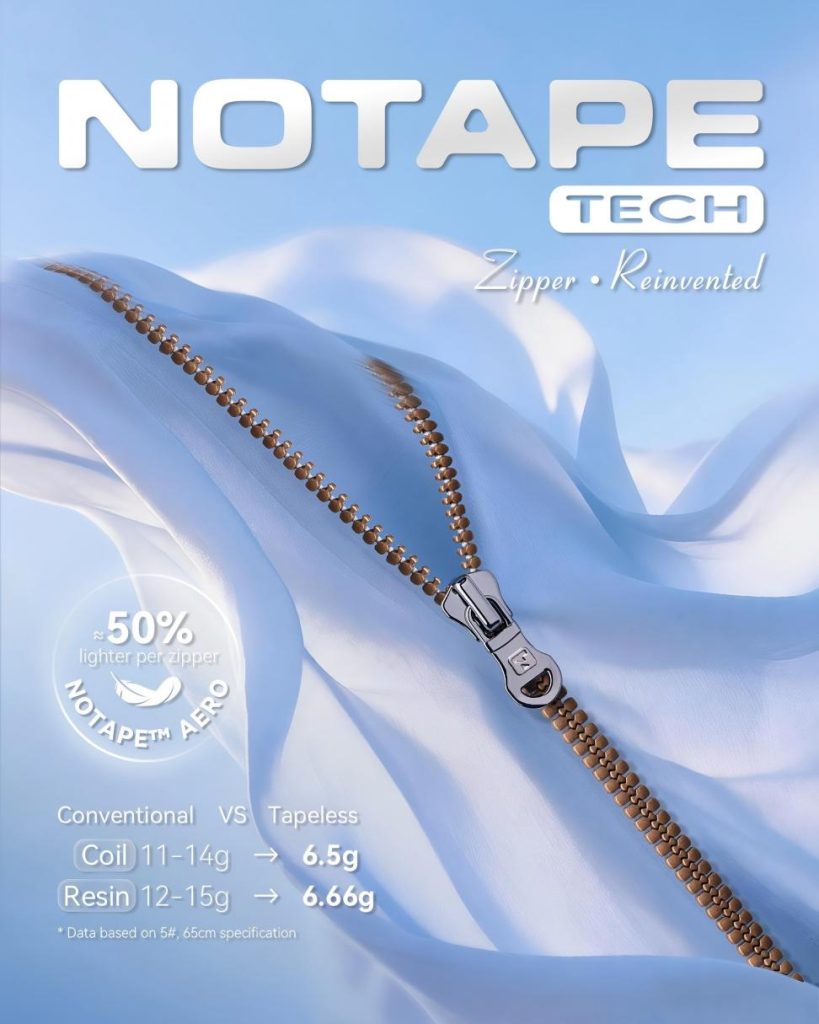
Consider a commonly used #5 Coil Zipper with a length of 65 cm.
| Zipper Structure | Approximate Weight |
| Conventional #5 Coil Zipper, 65 cm | 11–14 g |
| NOTAPE™ No Tape Coil Zipper, 65 cm | About 6.5 g |
| Approximate Weight Reduction | Nearly 50% per zipper |
A difference of several grams may seem limited when viewed as a single component. However, apparel weight is the combined result of fabrics, linings, trims, pockets, reinforcement layers and closure systems.
For lightweight outdoor jackets, cycling apparel, skin jackets, sun-protective clothing and sportswear, reducing approximately half of the zipper weight can contribute to the overall weight target without requiring designers to reduce garment coverage or remove functional details.
The result is not simply a lighter zipper. It gives product teams another area in which weight can be managed at the structural level.
What Changes When the Tape Is Removed?
A conventional Coil Zipper typically creates a layered assembly:
Chain elements + zipper tape + garment fabric
The NOTAPE™ structure simplifies this relationship:
Chain elements + garment fabric
By removing the separate tape layer, the No Tape Coil Zipper can create a thinner and less visually interrupted closure area.
For apparel designers, this may support:
•A cleaner transition between the zipper and garment panel
•Less material build-up around the closure
•A lighter and more flexible hand feel
•Reduced visual contrast from zipper tape
•Greater coordination between the closure and fabric surface
•More freedom in minimalist and lightweight garment design
The Coil Zipper version still requires defined garment assembly and sewing processes. Its distinction is the removal of the conventional textile zipper tape, rather than the elimination of all sewing operations.
Lightweight Design Is Also About Perception
Garment weight is measured in grams, but users also experience weight through thickness, stiffness and visual complexity.
A zipper with multiple overlapping layers may make a lightweight fabric feel heavier around the front opening, pocket or ventilation area. It can also create a visible boundary between the accessory and the garment.
The NOTAPE™ No Tape structure helps the zipper appear less like an additional component placed onto the fabric. Instead, the closure can become more closely integrated with the garment surface.
This characteristic is particularly relevant to categories such as:
•Outdoor apparel
•Sportswear
•Casualwear
•Cycling apparel
•Skin jackets
•Sun-protective clothing
•Hardshell jackets
•Ski apparel
Fabric thickness, elasticity, coating, surface structure and garment construction should still be evaluated before production. Lightweight design requires compatibility testing rather than relying on component weight alone.
From an Established Assumption to a Technology Zipper
The traditional zipper structure has existed for around 130 years, and textile tape has long been treated as an essential part of its construction.
NOTAPE™ began with a straightforward question: could a zipper function without that separate tape?
There were few existing drawings, references or production precedents available for this direction. Development therefore required repeated testing, adjustment and validation over an extended period.
The resulting No Tape Coil Zipper represents a structural reinterpretation rather than a cosmetic modification. It maintains the familiar opening and closing function while reconsidering how the zipper connects with the garment.
This is why the product can be described as both an Innovative Zipper and a Technology Zipper. Its value comes from changing the component architecture, not simply changing its colour, finish or appearance.
More Than a Reduction in Grams
The significance of the No Tape Coil Zipper is not limited to the difference between 11–14 g and approximately 6.5 g.
Removing the tape changes the relationship between the zipper and the garment. It can reduce layered bulk, simplify the visual closure line and create new possibilities for lightweight apparel construction.
For designers, the benefit is greater structural freedom. For apparel factories, it may reduce tape-related material handling and colour coordination. For brands, it provides a measurable component-level story around weight and resource use.
As garments continue to become lighter, thinner and more integrated, the NOTAPE™ Lightweight Zipper offers a different way to reconsider one of apparel’s most familiar components.
Sometimes, meaningful design progress begins by removing a layer that has always been assumed necessary.
FAQs
Q1: Are NOTAPE™ zippers water-resistant in rainy or heavy rain conditions?
Yes, NOTAPE™ provides a range of water protection solutions tailored to different garment applications and performance requirements. Depending on the end-use scenario, customers can choose from water-repellent solutions to higher-level water-resistant solutions.
Q2: How does the physical performance of NOTAPE™ zippers compare? Do they meet industry usage standards? Do they meet the standards used for traditional zippers?
NOTAPE™ is a global first and currently has no independent standard.
At present, testing is conducted with reference to the execution standards of traditional zippers.
All physical performance test data meets or exceeds existing industry standards (EU, US, and international standards).
Q3: How is the pricing of NOTAPE™ zippers?
NOTAPE™ is positioned as a premium solution. Higher cost reflects the innovation and technology involved.
Q4: Do you have third-party test reports?
Yes. Test reports from ITS, SGS, and other accredited third-party laboratories are available upon request.
Q5: Do you offer different levels of water protection?
Yes. NOTAPE provides a range of water protection solutions tailored to different garment applications and performance requirements. Depending on the end-use scenario, customers can choose from water-repellent solutions to higher-level water-resistant solutions.



Contact Us
In This Article
Related Posts
130 Years Later, Cars Were Reinvented by Electrification. What About the Zipper?
October 12, 2026
Waterproof Zipper without Coating Supplier | NOTAPE™ No Coating Zipper Technology
September 26, 2026
From No Tape to Water Resistance Without Coating: NOTAPE™ Rethinks the Zipper Through Its “Three-No” Design
September 14, 2026
NOTAPE™Returns to Intertextile Shanghai Apparel Fabrics with Groundbreaking NO TAPE, NO SEAM, NO COATING Zipper Innovation
August 06, 2026


