




The World’s First No Tape, No Seam Resin Zipper: Redefining How Zippers Connect with Fabric
By hqt
08, 2026Related Posts
130 Years Later, Cars Were Reinvented by Electrification. What About the Zipper?
October 12, 2026
Waterproof Zipper without Coating Supplier | NOTAPE™ No Coating Zipper Technology
September 26, 2026

From No Tape to Water Resistance Without Coating: NOTAPE™ Rethinks the Zipper Through Its “Three-No” Design
September 14, 2026

NOTAPE™Returns to Intertextile Shanghai Apparel Fabrics with Groundbreaking NO TAPE, NO SEAM, NO COATING Zipper Innovation
August 06, 2026
In 2026, sustainable apparel development is moving beyond fabric selection and recycled-fibre percentages. Brands are increasingly being asked to examine the complete product structure—including trims, closures, sewing processes and material combinations.
This shift is supported by measurable pressure across the textile value chain. The European Environment Agency reports that EU consumers purchased an average of 19 kg of clothing, footwear and household textiles per person in 2022. In the same year, the EU generated approximately 6.94 million tonnes of textile waste, while about 85% of household textile waste was not collected separately.
Against this background, the zipper can no longer be viewed only as a small functional accessory. Its materials, weight and connection with the garment also influence the overall product footprint.
Why Apparel Component Design Is Changing in 2026
Several regulatory developments are encouraging brands to reconsider how clothing products are constructed.
Textiles and apparel are identified as a top-priority group within the EU’s 2025–2030 Ecodesign for Sustainable Products Regulation working plan. It demonstrates the potential for a plethora of opportunities to enhance the efficiency of the use of resources and reduce the generation of wastes and the use of and impact on the climate. Indicative measures for the ecodesign of apparel are expected to be adopted in 2027.
The revised EU Waste Framework Directive came into force on October 16, 2025. It mandates Member States to implement extended producer responsibility for textile and footwear products. Producers are responsible for financing the collection and treatment of the products they place on the market.
From July 19, 2026, large companies are also prohibited from destroying unsold apparel, clothing accessories and footwear except under defined exemptions. The European Commission estimates that approximately 4–9% of textile products placed on the European market have historically been destroyed before use.
These developments make one question increasingly relevant:
Can the structure of a garment be simplified before unnecessary material becomes waste?
The Conventional Zipper Is a Layered Structure
A conventional Resin Zipper normally contains three connected layers:
Zipper teeth + textile tape + garment fabric
The teeth are first fixed to a separate textile tape. The tape is then positioned and sewn onto the garment panel.
This established method performs reliably, but it also introduces additional material and production requirements:
•Separate zipper tape production
•Tape dyeing and colour matching
•Tape inventory management
•Sewing thread and seam allowance
•An additional sewing operation
•Multiple material layers around the closure
For lightweight outdoor and performance apparel, these layers can also create visible thickness and stiffness along the zipper line.
NOTAPE™ Changes the Connection Point
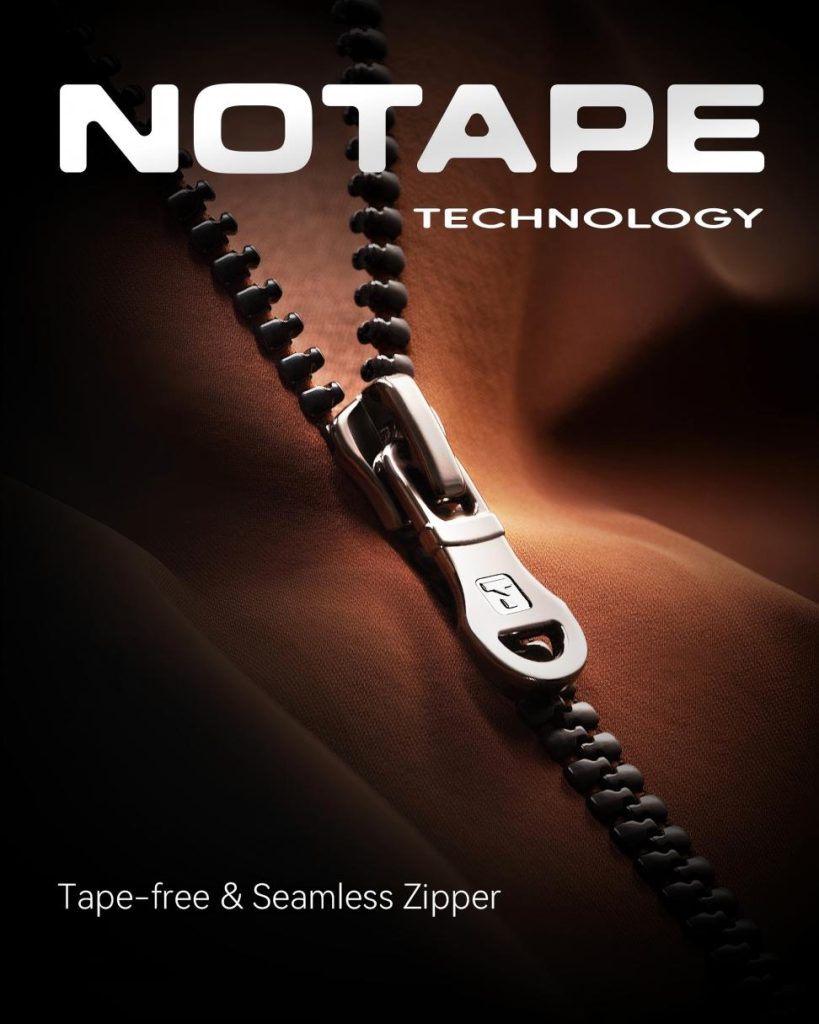
The World‘s First No Tape, No Seam Resin Zipper removes the separate textile tape and conventional zipper-sewing line.
Instead of assembling teeth, tape and fabric as three layers, NOTAPE™ engineers the zipper structure directly with the garment fabric:
Zipper teeth + garment fabric
The fabric no longer acts only as the material beside the zipper. It becomes part of the closure structure itself.
| Structural Element | Conventional Resin Zipper | NOTAPE™ No Tape, No Seam Resin Zipper |
| Separate textile tape | Required | Removed |
| Tape sewing | Required | Removed |
| Connection method | Tape sewn onto fabric | Zipper structure integrated directly with fabric |
| Material layers | Teeth, tape and fabric | Teeth and fabric |
| Visual appearance | Attached accessory line | Integrated closure line |
| Tape colour matching | Normally required | Not required |
This is not simply a visual adjustment. It changes how the zipper and fabric relate to each other.
The result is closer to an integrated garment component than a separately sewn accessory, while retaining the functional elements required for opening and closing: teeth, slider, puller, pin and box, and stoppers.
What Fabric Integration Means for Apparel Design
By removing the tape and conventional sewing line, the NOTAPE™ structure can create a cleaner transition between the closure and garment panel.
For designers, this supports:
•A thinner and less layered zipper area
•Cleaner, minimalist closure lines
•More flexibility in lightweight garment construction
•Reduced visual interruption from tape and stitching
•Closer coordination between the zipper and fabric surface
For apparel factories, the structure may also reduce tape-related material handling. There is no separate zipper tape inventory to track, no tape colour-matching cycle and no conventional sewing pass for attaching the zipper tape.
Implementation still requires fabric compatibility testing and defined processing parameters. Fabric thickness, elasticity, coating, surface structure and garment construction should be evaluated before production. The solution should therefore be developed as part of the garment engineering process rather than treated as a universal drop-in replacement.
Less Structure Can Mean Less Weight
The material difference can be seen in a #5, 65 cm Resin Zipper comparison:
| Zipper Structure | Reference Weight |
| Conventional Resin Zipper | Approximately 12–15 g |
| NOTAPE™ No Tape, No Seam Resin Zipper | Approximately 6.66 g |
The final weight varies according to zipper length, component specification, tooth design, slider selection, garment fabric and the conventional zipper used as the reference.
Even so, removing the separate tape and sewing structure provides a direct way to reduce the amount of material carried by each garment.
Across large production volumes, several grams per zipper can become a meaningful material difference.
Environmental Improvements Supported by Structural Simplification
The resource reductions against the corresponding conventional structure as the following:
| Environmental Indicator | Reported Reduction |
| Water consumption | Approximately 95% |
| Energy consumption | Approximately 32% |
| Chemical usage | Approximately 62% |
| Component weight | Approximately 25% |
| TÜV-certified carbon footprint | Approximately 26.6% |
Based on the stated #5 Resin Zipper conversion conditions, every 10,000 units can also save approximately 1,617 kg of CO₂ and reduce related production waste by up to 95%.*
These figures demonstrate why an Eco Zipper should not be evaluated only by the material name. The number of components, processing steps and connection methods also influence its environmental performance.
A Different Way to Think About the Zipper
The World’s First No Tape, No Seam Resin Zipper represents a structural reconsideration of a familiar garment component.
By integrating the zipper directly with the fabric, NOTAPE™ removes two long-established elements—the textile tape and the conventional sewing line. This creates a lighter, cleaner and more material-efficient closure structure for outdoor apparel, sportswear, casualwear, cycling apparel, skin jackets, sun-protective clothing, hardshell jackets and ski apparel.
For brands working toward measurable sustainability objectives, the significance lies not only in using a different zipper. It lies in redesigning how the zipper becomes part of the garment.
Sometimes, improving apparel sustainability begins not by adding another environmental feature, but by removing a structure that is no longer necessary.
*Based on #5 Resin Zipper conversion standards. The tree-equivalent calculation assumes that each fir tree absorbs approximately 18 kg of CO₂ annually. Environmental results may vary according to product specifications, manufacturing conditions and the conventional reference structure.
FAQs
Q1: Which country is NOTAPE™ from?
NOTAPE™ was founded in Hong Kong and serves clients globally.
Q2: Is NOTAPE™ a copy or imitation?
No. NOTAPE™ is the world’s first to develop no tape zipper solutions and holds exclusive patented technologies for both no tape coil zippers and no tape , no seam resin zippers.
Q3: What makes NOTAPE™ zippers uniquely different?
we come at a premium — because true innovation is rare. NOTAPE™ is not available to every brand. By integrating our tapeless zipper technology, your products gain a level of exclusivity and uniqueness that sets them apart.
Q5: Are NOTAPE™ zippers water-resistant in rainy or heavy rain conditions?
Yes, NOTAPE provides a range of water protection solutions tailored to different garment applications and performance requirements. Depending on the end-use scenario, customers can choose from water-repellent solutions to higher-level water-resistant solutions.



Contact Us
In This Article
Related Posts
130 Years Later, Cars Were Reinvented by Electrification. What About the Zipper?
October 12, 2026
Waterproof Zipper without Coating Supplier | NOTAPE™ No Coating Zipper Technology
September 26, 2026
From No Tape to Water Resistance Without Coating: NOTAPE™ Rethinks the Zipper Through Its “Three-No” Design
September 14, 2026
NOTAPE™Returns to Intertextile Shanghai Apparel Fabrics with Groundbreaking NO TAPE, NO SEAM, NO COATING Zipper Innovation
August 06, 2026


