




10,000 NOTAPE™ No Tape Sustainable Zippers: Making Green Value Visible
By hqt
08, 2026Related Posts
130 Years Later, Cars Were Reinvented by Electrification. What About the Zipper?
October 12, 2026
Waterproof Zipper without Coating Supplier | NOTAPE™ No Coating Zipper Technology
September 26, 2026

From No Tape to Water Resistance Without Coating: NOTAPE™ Rethinks the Zipper Through Its “Three-No” Design
September 14, 2026

NOTAPE™Returns to Intertextile Shanghai Apparel Fabrics with Groundbreaking NO TAPE, NO SEAM, NO COATING Zipper Innovation
August 06, 2026
Sustainability is beginning to show more fine-tuned depths in the fashion industry. No Tape Sustainable Zippers illustrates fine-tuned and measurable sustainable practices.
Gone are the days when brands communicated progress in the Environmental, Social, and Governance (ESG) realm through sweeping pledges. Buyers, consumers, investors, and supply-chain counterparts are focusing on the specifics. To what extent has carbon footprinting been reduced? What improvements have been made to the use of materials? Are the environmental claims substantiated with proof by a third party?
Against this background, even a small garment component can become part of a wider sustainability strategy.
When comparing 10,000 units of the #5 NOTAPE™ Resin Zippers, switching to the NOTAPE™ Eco Zippers is estimated to cut 1,617 kg of CO₂ emissions. This is the same as what 90 fir trees would absorb in one year.*
*This is based on #5 Resin Zipper conversion standards and based on the assumption that one fir tree absorbs 18 kg of CO₂ in a year. Actual results may differ based on the specifications of the zippers, the order structure, the production condition, the comparison baseline, and the scope of carbon accounting.
For an apparel company, the selection of a zipper integrates an easy-to-measure, flexible, and communicable element of environmental value.
The Apparel Industry Needs More Measurable ESG Actions
The environmental impact of textiles is extensive, from the sourcing of raw materials to manufacturing, dyeing, finishing, transportation, use, and disposal.
According to estimates by the United Nations Environment Program, the textile sector contributes about 2%-8% of global greenhouse gas emissions while consuming a significant amount of the world’s water supply. The footprint of the sector is also considerable due to the use of chemicals.
These challenges are compelling apparel companies to re-evaluate the way they manage ESG.
Instead of relying only on long-term corporate targets, brands are increasingly examining individual product decisions. Fabrics, trims, packaging, accessories, and production methods all contribute to the environmental profile of a finished garment.
A zipper may be small, but it is used across large production volumes. When an environmental improvement is repeated across 10,000, 100,000, or one million garments, the cumulative value becomes more visible.
What Do 10,000 Green Zippers Represent?
The environmental value of NOTAPE™ is based on simplifying the conventional zipper structure.
A traditional zipper normally includes a separate textile tape. NOTAPE™ removes this tape and engineers the zipper structure directly with the garment fabric. By reducing an additional material layer, the No Tape structure can help lower the carbon footprint associated with the zipper.
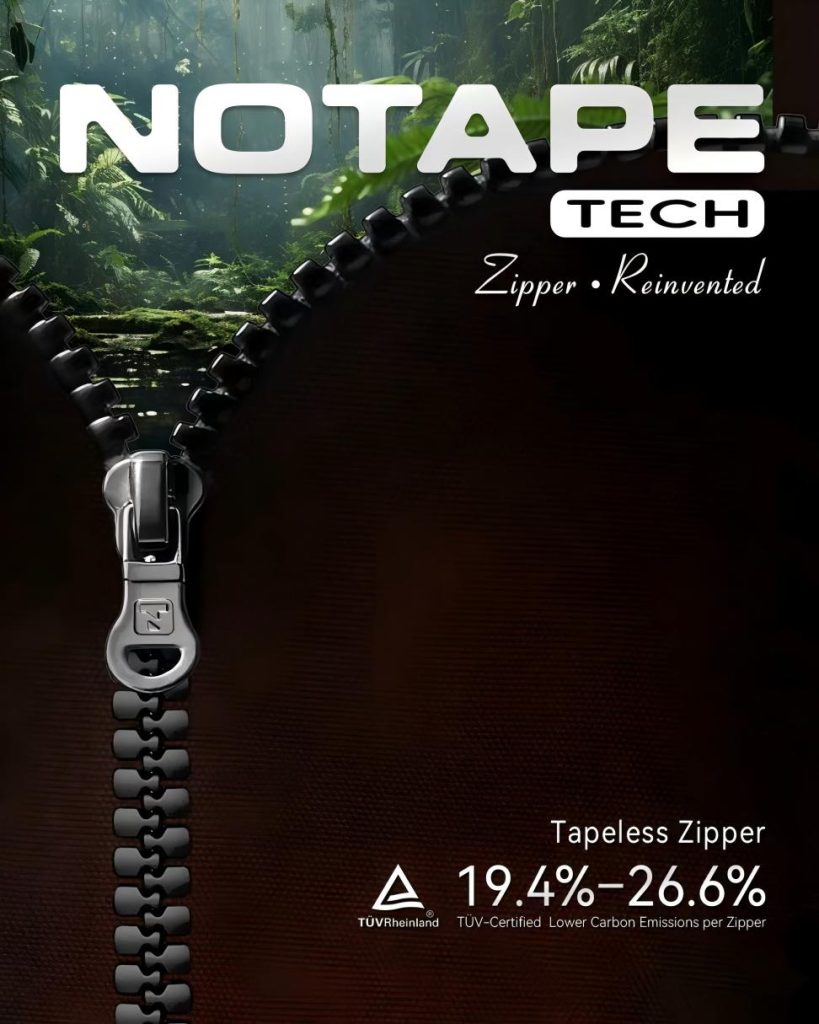
Based on TÜV-certified evaluations, NOTAPE™’s Coil Zipper and Resin Zipper structures have been shown to have around 19.4%–26.6% reductions in comparative carbon footprints versus the respective conventional zippers.
| ESG Indicator | Measurable Result |
| Quantity evaluated | 10,000 NOTAPE™ zippers |
| Zipper specification | #5 Resin Zipper |
| Estimated CO₂ reduction | 1,617 kg |
| Estimated tree equivalent | ~90 fir trees |
Once the seedlings become saplings and start contributing to the CO₂ absorption, it can take about 40-60 years for fir trees to mature. This estimate is based on CO₂ absorption when fir trees are grown and established, not when the seedlings are newly planted. Use of the verified data is to help brands understand the sustainability value of zipper procurement.
Instead of simply stating that a garment uses an Eco Zipper, a brand can explain the estimated carbon reduction associated with a defined product quantity and calculation boundary.
| Order Volume | Estimated CO₂ Reduction |
| 10,000 zippers | 1,617 kg |
| 100,000 zippers | 16,170 kg |
| 1,000,000 zippers | 161,700 kg |
The TÜV-certified carbon-footprint reduction of 19.4%–26.6% also gives brands third-party data for practical business use, including:
•Recording component-level reductions in ESG reports;
•Comparing conventional and Green Zipper sourcing options;
•Calculating the estimated carbon benefit of a collection;
•Adding verified data to product sustainability presentations;
•Supporting supplier scorecards and procurement reviews;
•Providing customers with clearer evidence behind environmental claims.
The calculation should always state the zipper specification, quantity, comparison baseline, and assessment boundary. This makes Sustainable Zipper communication more transparent and reduces reliance on general terms such as “eco-friendly”.
Sustainability Requirements Are Moving Closer to the Product
Policy developments are also encouraging companies to look more closely at product-level environmental performance.
The European Union’s Strategy for Sustainable and Circular Textiles sets out a 2030 vision in which textile products placed on the EU market are more durable, repairable, recyclable, and produced with greater respect for environmental requirements.
The EU Ecodesign for Sustainable Products Regulation also establishes a framework for improving product circularity and environmental sustainability. Its 2025–2030 working plan identifies textiles and apparel as priority product categories, with potential requirements covering areas such as material efficiency, climate impact, water use, waste, and product environmental information.
For apparel companies selling internationally, this direction suggests that environmental information may increasingly need to be connected to specific products, materials, and supply-chain decisions.
Choosing a zipper supported by defined carbon-footprint data can therefore contribute to a more structured ESG information system.
Small Components Create Scalable Green Value
A reduction of 1,617 kg of CO₂ across 10,000 zippers may be modest compared with the total footprint of a global apparel supply chain.
Its value lies in being specific, repeatable, and scalable.
When measurable improvements are applied across more styles, collections, factories, and annual orders, small component decisions can support broader ESG progress.
NOTAPE™ shows the Green Zipper solution potential by using one material layer less for the example of a reversible zipper pull in the NOTAPE™ supply chain.
For brands implementing sustainability, the first zipper can be the first step towards a visible green commitment that’s likely to multiply on every product manufactured.
FAQs
Q1: Are there requirements regarding fabric type or thickness when using NOTAPE™ zippers?
Currently, NOTAPE™ technology is more suitable for synthetic fibers such as nylon and polyester, as well as woven, knitted, low-elastic, or non-elastic fabrics. The applicability of other materials is still under development and testing.
Q2: Are NOTAPE™ zippers water-resistant in rainy or heavy rain conditions?
Yes, NOTAPE™ provides a range of water protection solutions tailored to different garment applications and performance requirements. Depending on the end-use scenario, customers can choose from water-repellent solutions to higher-level water-resistant solutions.
Q3: What does NOTAPE™ mean?
NOTAPE” means eliminating the traditional fabric tapes of the zipper, allowing the zipper to integrate directly with the fabric structure.
Q4: How can NOTAPE™ zippers be purchased? Will they be available to general consumers or individual buyers?
At present, NOTAPE™ works exclusively with apparel designers and industry professionals.
Q5: How does NOTAPE™ SEAL achieve water-resistant? Are you sure there’s no film or water-resistant coating?
The core of the NOTAPE™ SEAL lies in three innovations: No tape, No seam, and No coating.



Contact Us
In This Article
Related Posts
130 Years Later, Cars Were Reinvented by Electrification. What About the Zipper?
October 12, 2026
Waterproof Zipper without Coating Supplier | NOTAPE™ No Coating Zipper Technology
September 26, 2026
From No Tape to Water Resistance Without Coating: NOTAPE™ Rethinks the Zipper Through Its “Three-No” Design
September 14, 2026
NOTAPE™Returns to Intertextile Shanghai Apparel Fabrics with Groundbreaking NO TAPE, NO SEAM, NO COATING Zipper Innovation
August 06, 2026


