




Ultralight Zipper for Outdoor Clothing: Structure, Weight & Performance Innovation
By hqt
09, 2026Related Posts
Waterproof Zipper without Coating Supplier | NOTAPE™ No Coating Zipper Technology
September 26, 2026
From No Tape to Water Resistance Without Coating: NOTAPE™ Rethinks the Zipper Through Its “Three-No” Design
September 14, 2026

NOTAPE™Returns to Intertextile Shanghai Apparel Fabrics with Groundbreaking NO TAPE, NO SEAM, NO COATING Zipper Innovation
August 06, 2026

Eco Zippers 2.0: How NOTAPE™ Tape-less Seamless Zipper Technology Redefines Sustainable Closures
June 15, 2026
Designing an outdoor jacket for a long-distance mountain route means every detail must be considered, including the placement of each individual gram of fabric.
Jackets that resemble a shell must be designed to keep the hiker comfortable during a shift in weather and maintain full range of motion in the arms. Designers must consider the fabric weight and efficiency of the insulation as well as the patterns of the garment. Often times, designers will overlook one small part, the zipper.
A zipper makes up a very small part of a garment, but its design affects the weight distribution and the experience of wearing the garment.
This is why the development of Ultralight Zipper for Outdoor Clothing has become an important direction in technical apparel design.
At NOTAPE™, we started from a simple question:
If outdoor clothing continues becoming lighter, can the zipper structure also evolve?
The answer led us to rethink a traditional zipper construction that had remained almost unchanged for more than a century.
Scenario 1: Design of a Lightweight Hiking Jacket for Long-Distance Hiking
A hiker plans a multi-day mountain trip and has to think about what jacket to take.
A jacket for long-distance hiking has to account for changing temperatures and provide wind protection, but extra weight for the jacket can cause fatigue during the hike.
For outdoor brands, making a lightweight jacket is not about using a single, lightweight material. It is about using lightweight designs for every part of the jacket.
| Garment Element | Lightweight Design Approach |
| Fabric | Reduce the weight of the textiles and maintain protection |
| Insulation | Improve the warmth to weight ratio |
| Pattern | Improve the mobility and comfort of the jacket |
| Zipper | Reduce the structural weight of the jacket |
Traditionally, zippers rely on textile tape for part of the construction. While tape provides support for sewing, it also increases the bulk of the zipper.
NOTAPE™ looks at whether the zipper can be simplified to remove tape.
This leads to a new approach where:
•The essential zipper components are kept
•Unnecessary structural layers are removed
•The zipper is more directly integrated with the fabric of the garment
For lightweight hiking jackets, this means the zipper closures become part of the overall weight reduction for the jacket.
Scenario 2: A Technical Shell Jacket Where Every Detail Counts
When creating a jackets for the alpine environment, designers have to strike a balance between:
•Lightweight construction
•Structural reliability
•Aesthetic appeal
A traditional zipper consists of:
•Teeth
•Slider
•Puller
•Tape
•Pin & box
•Stoppers
•And sewing attachment
For NOTAPE™, the focus is on:
•Teeth
•Slider
•Puller
•Pin & box
•Stoppers
No Tape structure allows for zipper construction to be simplified.
The difference can be seen in sample eliminations.
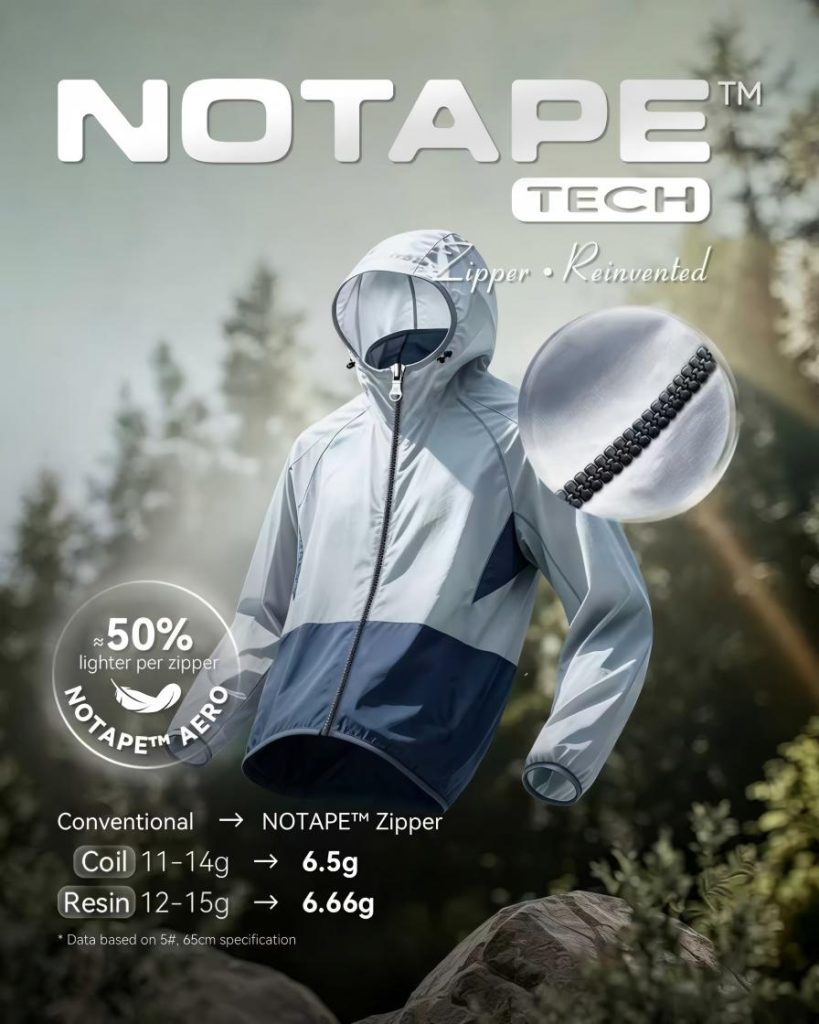
Example: 5# zipper, 65cm length
| Zipper Type | Traditional Structure | NOTAPE™ No Tape Zipper |
| Resin Zipper | 12–15g | 6.66g |
| Coil Zipper | 11–14g | 6.5g |
For one jacket, the difference may appear small. However, when multiplied across thousands or millions of garments, component-level optimization becomes meaningful.
This is the thinking behind an Ultralight Zipper for Outdoor Clothing—small structural improvements supporting larger product goals.
Scenario 3: Cycling Apparel That Requires Freedom of Movement
Designing cycling apparel focuses on mobility.
Something as simple as a lightweight cycling jacket can be ruined by excess weight or rigid components.
While creating cycling apparel, the type of zippers used impacts:
•The distribution of garment weight
•The flexibility of the front panel
•Comfort in the overall wear
The No Tape structure allows zipper integrations to be simpler, giving companies the ability to make more minimalistic apparel.
Instead of adding more layers to improve performance, the design philosophy is shifting to:
Removing what is unnecessary and improving what remains.
Scenario 4: Ski Apparel Balancing Performance and Weight
Ski jackets need to keep the user comfortable while also allowing the jacket to protect the user from the harsh conditions.
When designing ski apparel, brands have to keep in mind:
| Requirement | Zipper Design Consideration |
| Lightweight performance | Reduce unnecessary material |
| Frequent use | Maintain stable opening and closing |
| Modern aesthetics | Support cleaner garment appearance |
| Production efficiency | Simplify manufacturing processes |
An Ultralight Zipper for Outdoor Clothing is not just a lighter zipper. It is a new approach to how the zipper integrates with the garment system.
Structural Optimization Behind Ultralight Zipper Design
Lightweight outdoor apparel focuses on reducing the weight of fabric but not at the expense of other systems in the garment. Zippers, for example, must also be lightweight.
An Ultralight Zipper for Outdoor Clothing focuses on more than using lighter materials. It requires a new structure to balance weight and integration with the garment system while keeping production costs low.
NOTAPE™ takes a structural optimization approach to zipper design.
| Traditional Zipper Design | Structural Optimization Approach |
| Multiple construction layers | Focus on essential functional components |
| Separate zipper tape structure | No Tape zipper solutions |
| Additional material usage | Reduced unnecessary structural elements |
| Complex integration process | More direct connection between zipper and garment |
Key Design Considerations
•Weight Efficiency
Minimize extra structural elements to lighter construct garment.
•Design Flexibility
Allows outdoor apparel brands to make minimalistic and performance-driven outdoor apparel.
•Manufacturing Optimization
Streamline the processes related to tape and improve the efficiency of your production.
•System-Level Thinking
Think about how the entire structure of a garment integrates with zippers, rather than viewing zippers as an additional accessory.
NOTAPE™ is focused on improving structures to provide the next generation of ultralight outdoor apparel with features to support cycling and skiing.
We believe that innovation in outdoor apparel will come from considering the smallest details. Progress may also come from rethinking the smallest components.
From hiking jackets and cycling clothing to ski apparel and lightweight shells, NOTAPE™ continues developing No Tape zipper solutions to help brands explore new possibilities in lightweight garment design.
A lighter zipper may be a small step—but for outdoor clothing innovation, every gram and every structure matters.
FAQs
Q1: Does every garment using a NOTAPE™ zipper require customization?
Good question. Not every piece requires customization, but each zipper style must undergo preliminary validation testing before production.
Q2: If a NOTAPE™ zipper is damaged, can it be replaced or repaired? How is it repaired? Will it affect the garment?
Individual zipper teeth on plastic zippers can be repaired without affecting the garment.
Q3: How is the pricing of NOTAPE™ zippers?
NOTAPE™ is positioned as a premium solution. Higher cost reflects the innovation and technology involved.
Q4: What does NOTAPE™ mean?
NOTAPE” means eliminating the traditional fabric tapes of the zipper, allowing the zipper to integrate directly with the fabric structure.
Q5: How is NOTAPE™ different from other “”Tape-free sewn”” zippers solutions? Does it require sepcial sewing machinery?
Thank you for your interest in NOTAPE™ zipper. The key difference are:
- NOTAPE™ offers globally exclusive no tape coil zipper and no tape, no seam resin zipper.
2. NOTAPE™ zippers are based on proprietary patented technologies
If you’re open to share your industry and brand, we can provide more relevant technical details.



Contact Us
In This Article
Related Posts
Waterproof Zipper without Coating Supplier | NOTAPE™ No Coating Zipper Technology
September 26, 2026
From No Tape to Water Resistance Without Coating: NOTAPE™ Rethinks the Zipper Through Its “Three-No” Design
September 14, 2026
NOTAPE™Returns to Intertextile Shanghai Apparel Fabrics with Groundbreaking NO TAPE, NO SEAM, NO COATING Zipper Innovation
August 06, 2026
Eco Zippers 2.0: How NOTAPE™ Tape-less Seamless Zipper Technology Redefines Sustainable Closures
June 15, 2026


